


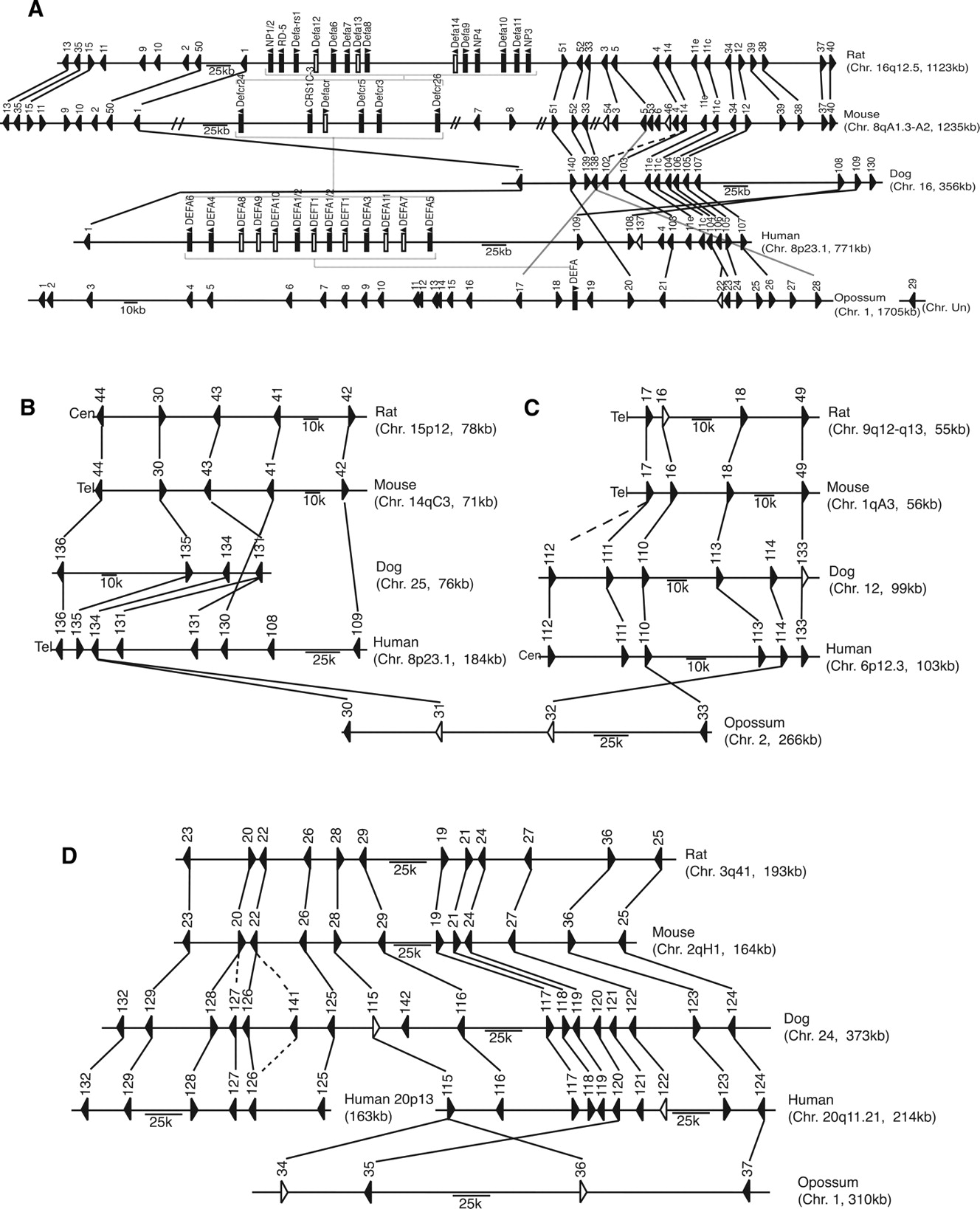
Figure 3.
Synteny map of mammalian alpha- and beta-defensin gene clusters (modified from Patil et al. 2005). Four different beta-defensin clusters (A, B, C, D) are found in rat, mouse, and dog. Five clusters are found in humans due to a split in cluster D. The opossum contains three clusters suggesting that eutherian clusters B and C evolved from a single cluster in ancestral mammals. The alpha-defensins (cluster A) are denoted by rectangles. Arrows show transcriptional orientation. Pseudogenes are shown in white, and putative functional genes in black. Orthologs, based on phylogenetic analyses, are connected.


