


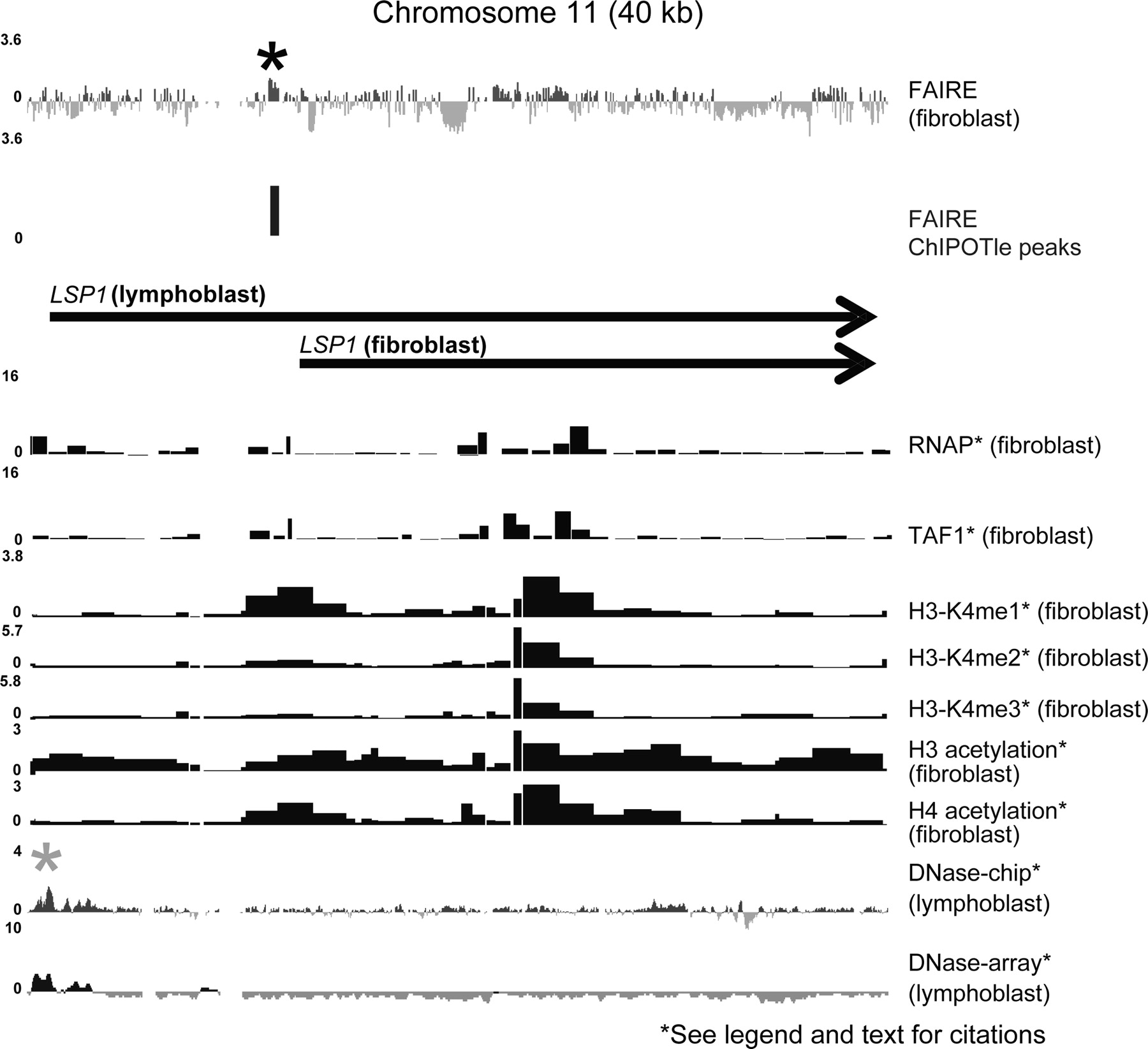
Tissue-specific accessibility of the LSP1 promoter at alternative TSSs FAIRE from fibroblasts and the DNaseI hypersensitivity data (Crawford et al. 2006; Sabo et al. 2006) from lymphoblastoid cells correspond to alternative, tissue-specific promoter usage at the LSP1 gene. On the top track, an asterisk marks the peak in the raw FAIRE data that corresponds to the TSS shown to be active in fibroblast cells. Data corresponding to RNAP, TAF1, and the histone modifications from adult and embryonic lung fibroblast cells are shown in the tracks below (Kim et al. 2005a, b; Koch et al. 2007). These tracks are also consistent with the utilization of this TSS in fibroblast cells. The bottom two tracks show DNaseI hypersensitivity results from lymphoblast cells, with a peak that corresponds only to the TSS for the lymphoblast-specific transcript (gray asterisk). An unannotated TSS about 10 kb downstream of the second TSS is suggested by the FAIRE signal (upper track, just below the 10−25 cutoff for peak detection) and the strong ChIP–chip signals. The units of data for each track are described in Figure 2. The region shown corresponds to chromosome 11 coordinates 1,830,000 to 1,870,000.



