


U6 snRNA pseudogenes in the human genome
Click on table to view larger version.
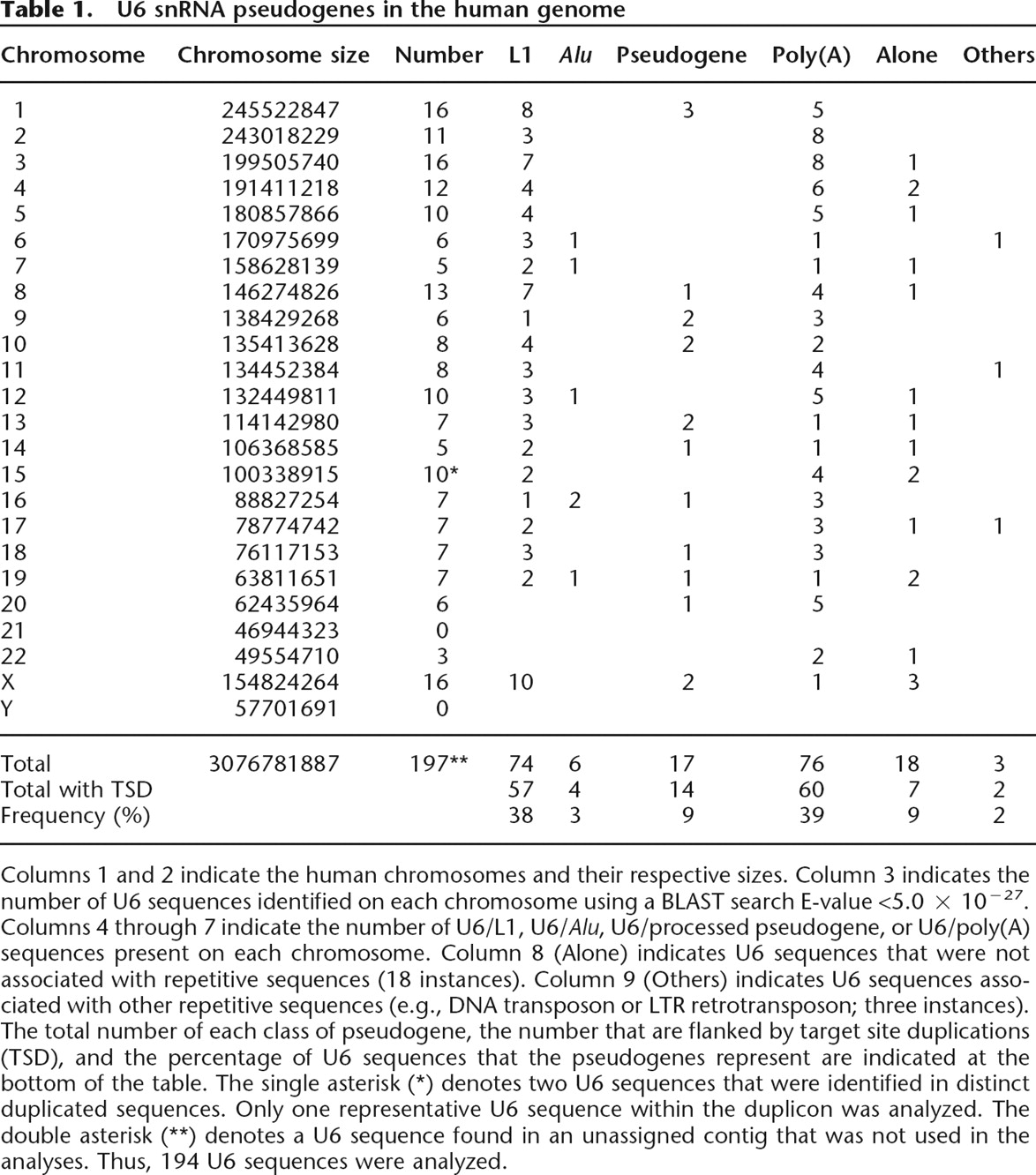
Columns 1 and 2 indicate the human chromosomes and their respective sizes. Column 3 indicates the number of U6 sequences identified on each chromosome using a BLAST search E-value <5.0 × 10⁻²⁷. Columns 4 through 7 indicate the number of U6/L1, U6/Alu, U6/processed pseudogene, or U6/poly(A) sequences present on each chromosome. Column 8 (Alone) indicates U6 sequences that were not associated with repetitive sequences (18 instances). Column 9 (Others) indicates U6 sequences associated with other repetitive sequences (e.g., DNA transposon or LTR retrotransposon; three instances). The total number of each class of pseudogene, the number that are flanked by target site duplications (TSD), and the percentage of U6 sequences that the pseudogenes represent are indicated at the bottom of the table. The single asterisk (*) denotes two U6 sequences that were identified in distinct duplicated sequences. Only one representative U6 sequence within the duplicon was analyzed. The double asterisk (**) denotes a U6 sequence found in an unassigned contig that was not used in the analyses. Thus, 194 U6 sequences were analyzed.



