


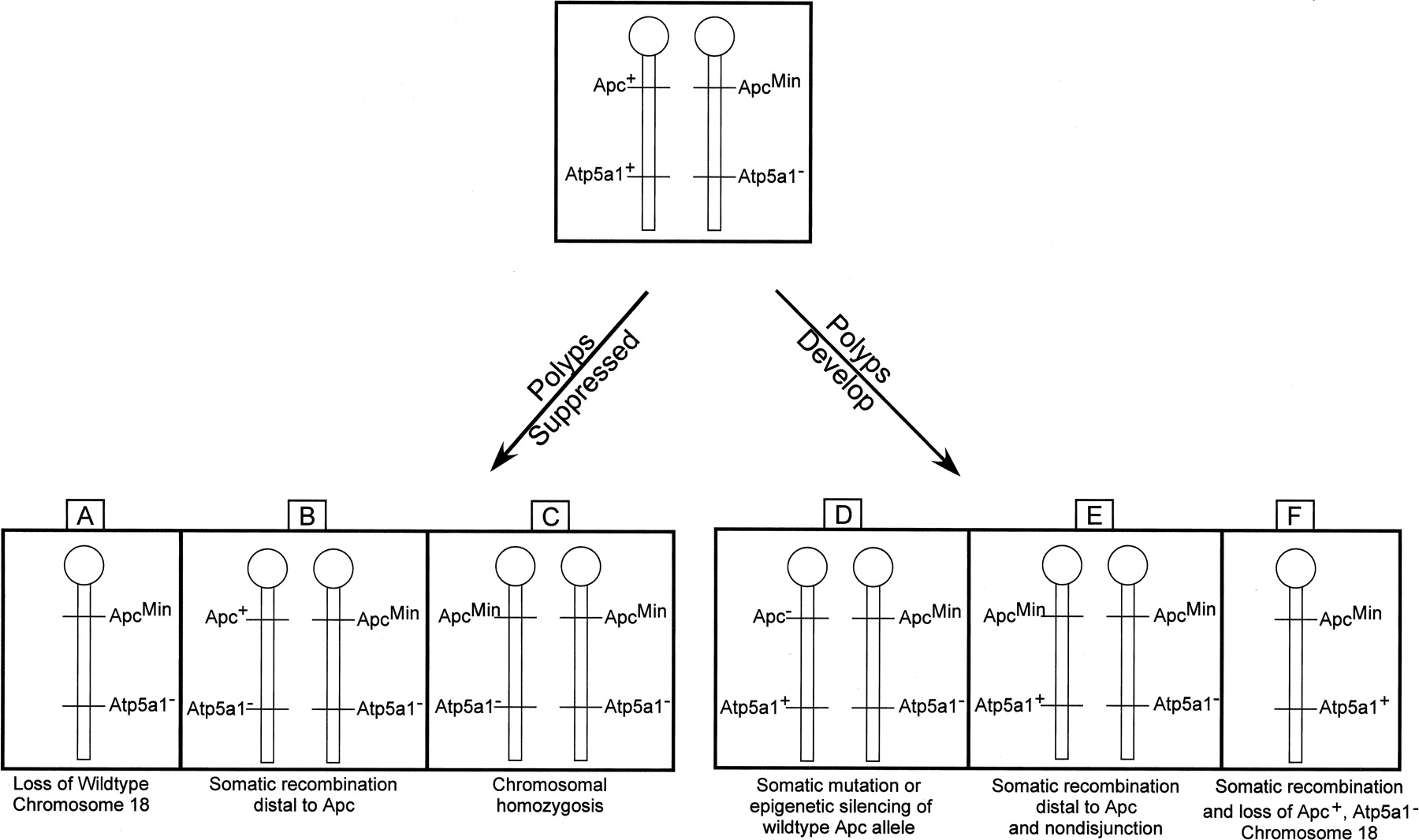
Mechanism of Mom2R suppression of ApcMin-induced polyposis. The chromosome 18 homologs present in an ApcMin/+ Atp5a1+/− mouse are shown. Previous work has shown that in the B6 mouse, the major mechanism of polyp formation involves loss of the entire wild-type chromosome 18 (A). If this occurs, a cell would lose its wild-type Atp5a1+ allele and die. Similarly, if somatic recombination distal to Apc (B) or chromosomal homozygosis (C) of the ApcMin Atp5a1− chromosome occurs, the cell would have no wild-type Atp5a1+ allele and die. Therefore, these mechanisms would prevent stem cells from developing into polyps. However, if both chromosome 18 homologs remain (D), polyps could develop in cells that have their wild-type Apc allele silenced or inactivated. In this case, a cell would retain its wild-type Atp5a1+ allele. Similarly, recombination between the Apc and Atp5a1 loci could occur, followed by loss of the chromosome containing the Apc+ and Atp5a1− alleles (F) or nondisjunction (E). In these cases, cells retaining the mutant ApcMin allele and the wild-type Atp5a1+ allele could form polyps.


