


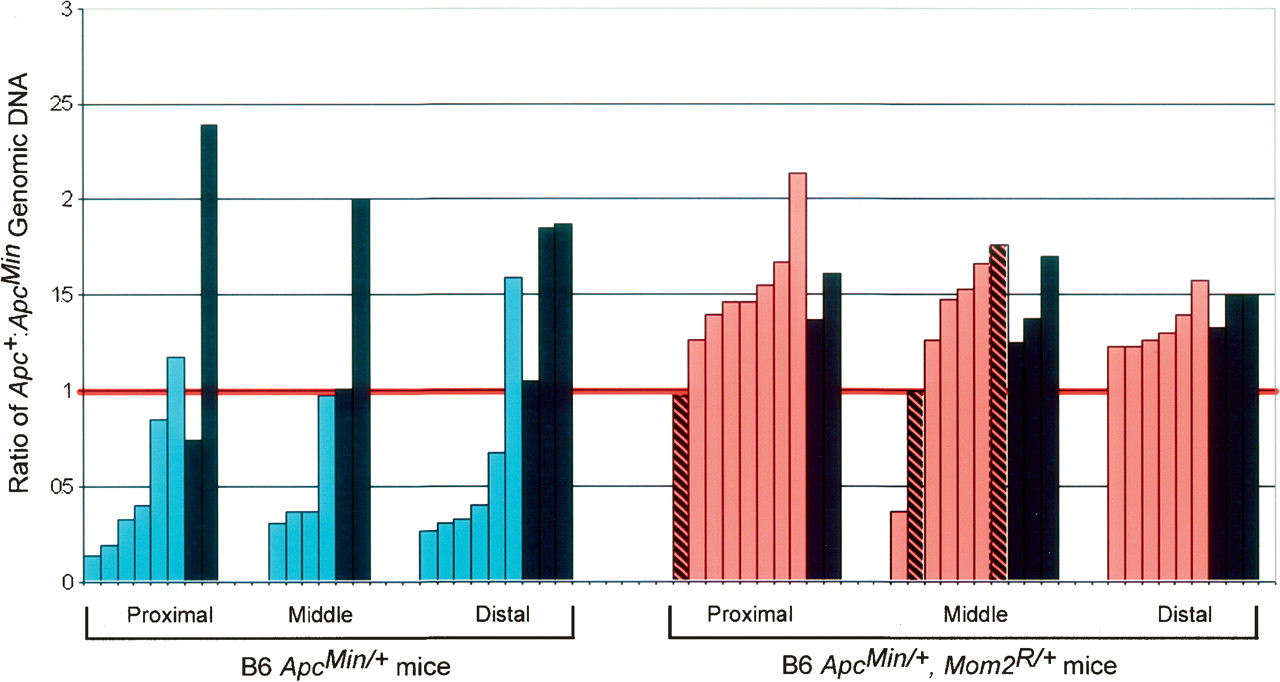
Quantitation of the Apc+:ApcMin ratio in normal and adenoma tissues in Mom2R/+ mice. Paraffin-embedded polyp and normal tissues were microdissected from slides. DNA was isolated using Qiagen DNeasy Tissue Kit. Genomic DNA was genotyped for the ApcMin mutation, PCR products run on a 4% agarose gel, and scanned using an EtBr filter on a Typhoon scanner. Ratios were quantified using ImageQuant 5.2. Values reflect the average of duplicate trials. Black bars represent normal tissue; turquoise bars represent polyps from B6 ApcMin/+, Mom2+/+ mice (aged ∼4–5 mo); salmon bars represent polyps from B6 ApcMin/+, Mom2R/+ mice (aged ∼15–17 mo). Hatched bars represent tumors that progressed to carcinomas. A ratio of 1.0 (red line) represents the ideal Mendelian 1:1 ratio of Apc+:ApcMin alleles expected in genomic DNA from a normal heterozygote. Ratios below 0.5 suggest loss of the Apc+ allele, whereas ratios above 1.5 suggest loss of the ApcMin allele. The ratios of normal tissue from ApcMin/+, Mom2+/+ mice (1.56 ± 0.62) do not appear to vary from the ratios of normal tissue from ApcMin/+, Mom2R/+ mice (1.46 ± 0.15) (P > 0.6, t-test). Interestingly, comparison of the ratios of tumor (1.38 ± 0.35) to normal (1.46 ± 0.15) tissues from ApcMin/+, Mom2R/+ mice indicate that they are quite similar (P > 0.5, t-test), suggesting that most tumors from ApcMin/+, Mom2R/+ mice retain both Apc alleles. In contrast, comparison of the ratios of tumor (0.54 ± 0.41) to normal (1.56 ± 0.62) tissues from ApcMin/+, Mom2+/+ mice show a striking difference (P < 2 × 10⁻⁴, t-test), suggesting that most polyps lose the Apc+ allele. Furthermore, the ratios of tumor tissue from ApcMin/+, Mom2+/+ mice (0.54 ± 0.41) differ significantly from the ratios of tumor tissue from ApcMin/+, Mom2R/+ mice (1.38 ± 0.35) (P < 3 × 10⁻⁷, t-test). These data indicate that most tumors in ApcMin/+, Mom2R/+ mice arise by a mechanism different from that occurring in ApcMin/+, Mom2+/+ mice.


