


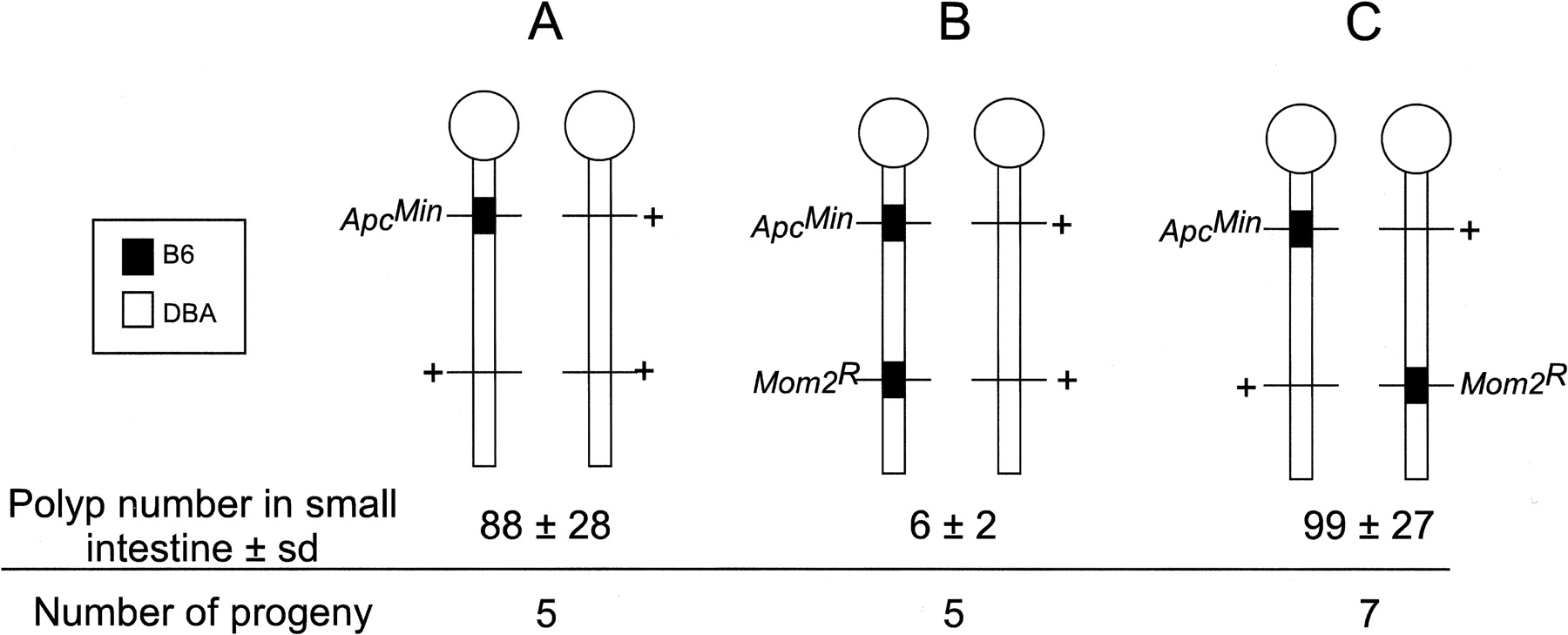
The cis–trans test reveals that the Mom2R mutation functions only when in cis with the ApcMin mutation. Two crosses were established to test whether Mom2R could function in trans as well as in cis. Three mating cages of DBA.B6 Mom2R/+ × DBA.B6 ApcMin/+ mice produced progeny that carried only the ApcMin mutation on chromosome 18 (A) or progeny that carried the ApcMin mutation on one chromosome 18 homolog and the Mom2R mutation on the other chromosome 18 homolog (C, in trans). Three mating cages of DBA/2J × DBA.B6 ApcMin/+, Mom2R/+ mice produced progeny that carried both the ApcMin and Mom2R mutations on the same chromosome 18 homolog (B, in cis). All parents of these progeny were at the N9–N12 backcross generations. The chromosomes show the positions of the Apc and Mom2 alleles on chromosome 18 homologs. Below the chromosomes is shown the average number of polyps ± standard deviation. Statistical analyses showed that there is no significant difference in polyp numbers between the control group carrying only the ApcMin allele and the group that has ApcMin and Mom2R in trans. (A vs. C, P > 0.5). In contrast, the only progeny that show highly significant differences with decreased polyp numbers is the ApcMin group that has Mom2R in cis (B vs. A, P < 0.0001; B vs. C, P < 0.0001).


