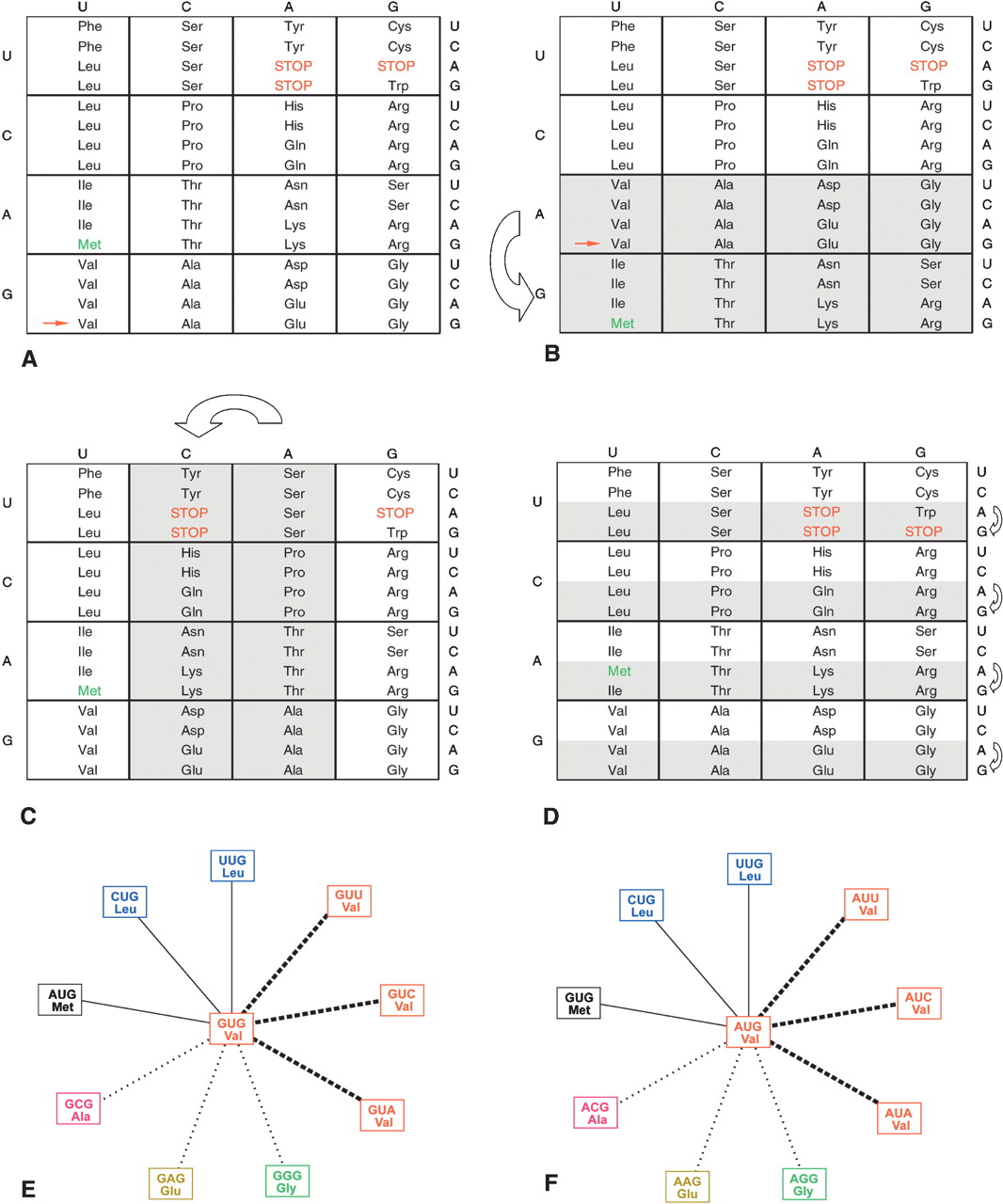
Alternative genetic codes. (A) The real code. (B) An alternative code obtained by an A↔G permutation in the first position. (C) An alternative code obtained by an A↔C permutation in the second position, and (D) A↔G permutation in the third position. Stop codons are marked in red, start (Met) codons in green. Codons that are changed relative to the real code are in gray. There are 4! × 4! × 2 = 1152 alternative codes obtained by independent permutations of the nucleotides in each of the three codon positions. (E,F) Structural equivalence of real and alternative genetic codes. For example, (E) the nine neighboring codons of the Valine codon marked with a red arrow in the real code (shown in A) are the same as (F) the nine neighboring codons of the Valine codon marked with a red arrow in the alternative code shown in B. Solid lines connect codons differing in the first letter, dotted lines connect codons differing in the second letter, and dashed lines connect codons differing in the third letter. Different amino acids are displayed in different colors. This equivalence applies to all codons.