


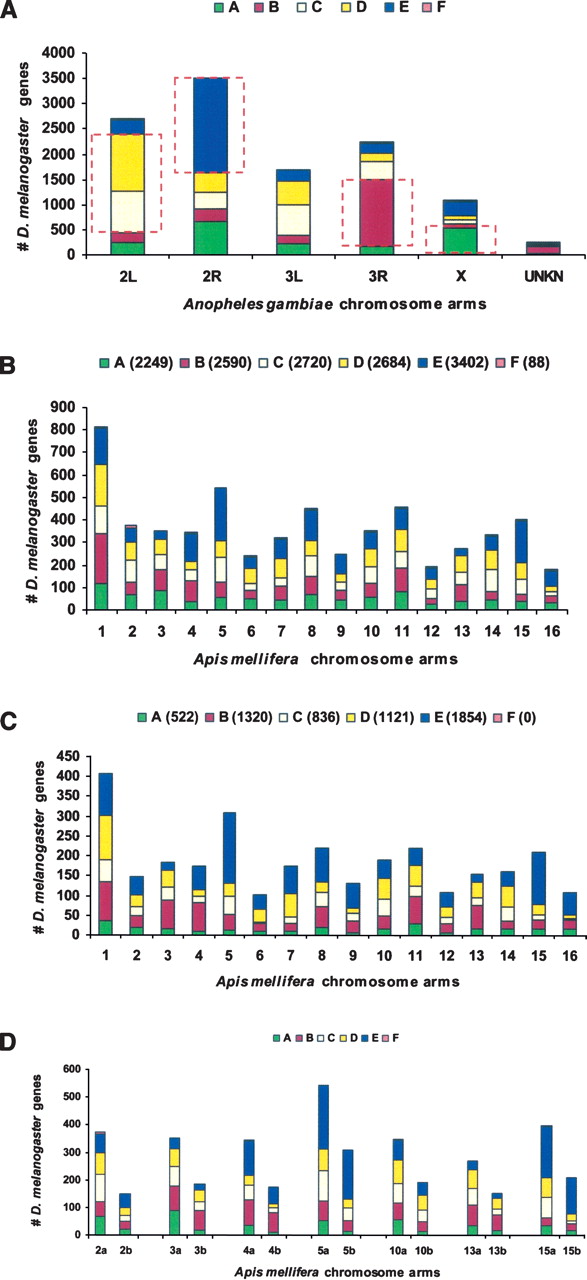
Impact of PRGs on more distant genome comparisons. (A) Chromosome arm correspondence between D. melanogaster and A. gambiae. Arm correspondence was inferred based on majority of D. melanogaster orthologous genes (from Muller elements A–F) found on A. gambiae chromosome arms. For example, Drosophila Muller E corresponds to A. gambiae arm 2R. Other relationships were inferred as follows: Drosophila A and A. gambiae X, B and 3R, C and 2L, D and 2L. Genes in these sets (shown boxed) are inferred to colocalize on an ancestral chromosome arm that was the primary contributor to the extant arms in these species. (B) D. melanogaster orthology with A. mellifera (honeybee). D. melanogaster genes (number of genes in the query set are shown in parentheses for each Muller element) with orthologs are distributed across various arms of A. mellifera. (C) Orthology with inferred ancestral colocated set from A. The set of ancestrally colocated D. melanogaster genes shown boxed in A, are mapped across various arms of A. mellifera. Numbers in parentheses show the number of genes from each Drosophila Muller element that are part of this query set. This mapping filters out noise due to PRGs over this long evolutionary distance and highlights contributions of ancestral arms to the honeybee genome organization. For example, the ancestral arm corresponding to D. melanogaster Muller element E and A. gambiae arm 2R is the primary contributor to honeybee chromosome 5. (D) Removal of PRGs enhances correlated chromosomal locations between honeybee and Drosophila. A side-by-side comparison of orthology using all D. melanogaster genes versus the inferred colocated set from A shows how reducing the contributions of PRGs enriches the signal from primary arm contributors. For example, eliminating PRGs from A. mellifera chromosome 5 (5a vs. 5b) and chromosome 15 (15a vs. 15b) shows the ancestral arm corresponding to Drosophila Muller element E (A. gambiae 2R) as the primary contributor. Similarly, contributions of the ancestral arm corresponding to Drosophila Muller element B (A. gambiae 3R) stand out for A. mellifera chromosomes 3 and 4.


