


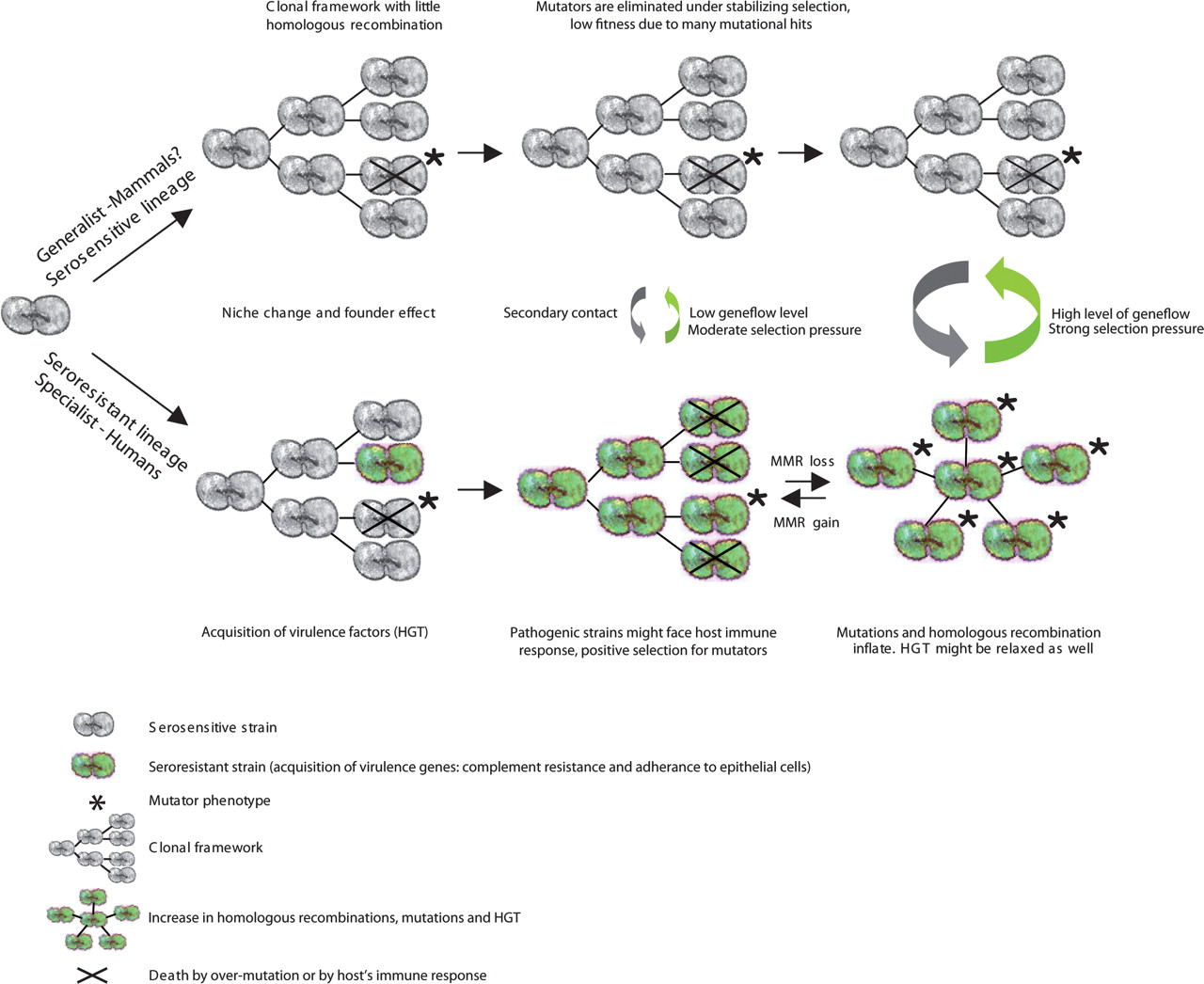
Model of evolutionary mechanisms that link sex and virulence. Virulence determinants are assumed to be introduced initially to a lineage by HGT. We deduce that (at least) two events were needed to convert an ancestral avirulent M. catarrhalis into virulent organisms. Within each population, mutators arise at low frequencies by random mutations. Mutator strains are transient within each population because they are eliminated because of lower fitness (crosses). But virulent strains face selection pressures for more rapid diversification in response to host immune defenses, resulting in higher frequencies of mutators in the seroresistant population. The frequency of transient mutators determines the population structure. At low frequencies, populations are largely asexual (clonal), whereas sex becomes more frequent with increasing mutator frequency. As a result, virulent bacteria are expected to possess patchy sexual structure within a generally asexual framework, while avirulent strains are largely clonal.



