


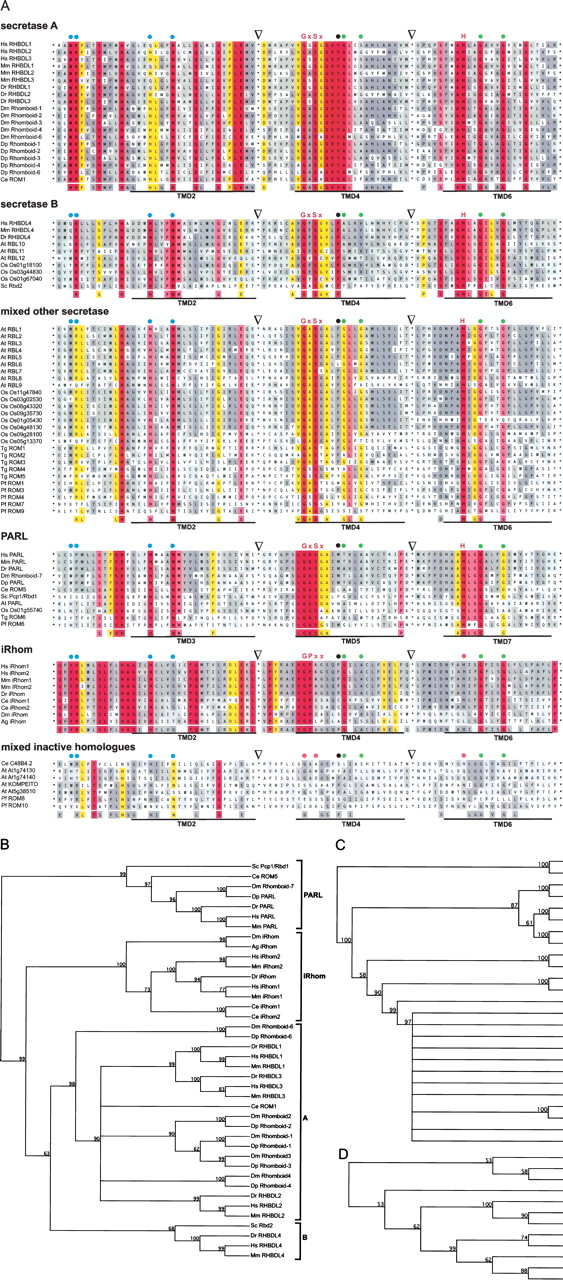
Phylogeny of eukaryotic rhomboids. Phylogenetic and functionally based analysis of rhomboid proteases and catalytically inactive homologs from human (Homo sapiens, Hs), mouse (Mus musculus, Mm), zebrafish (Danio rerio, Dr), Drosophila melanogaster (Dm), Drosophila pseudoobscura (Dp), Caenorhabditis elegans (Ce), Saccharomyces cerevisiae (Sc), Toxoplasma gondii (Tg), Plasmodium falciparum (Pf), Arabidopsis thaliana (At), and rice (Oryza sativum, Os). For accession numbers see below. (A) Multiple-sequence alignment of the conserved region according to structure-based TMD prediction (see Fig. 1). The sequences are classified into secretase-type (A, B, and other), PARL-type, iRhoms, and mixed inactive homologs. For secretase rhomboids, iRhoms and inactive homologs the C-terminal portion of L1, TMD2, TMD4, and TMD6 were used for the alignment; for PARL and its orthologs the topological equivalent portion of L2, TMD3, TMD5, and TMD7 are shown; the junctions of artificial splices are indicated by triangles. The degree of similarity is color-indicated as in Figure 1; for rhomboid proteases the key catalytic residues (GxSx and H) are highlighted (for iRhoms, the conserved GPxx instead); other functionally and structurally important positions are highlighted as described in Figure 1; TMDs are underlined. For a quantitative Two-Sample Logo comparison of the different subgroups, see Figure S1. Phylogenetic tree of rhomboid proteases and iRhoms in animals and yeast (B), plants (C), and apicomplexan parasites (D). Dendrograms were constructed by UPGMA analysis of the alignment in Figure 3A. Clades are indicated by square brackets; bootstrap values that represent the statistical significance are indicated in the internal nodes; orthology relationships of Arabidopsis and rice rhomboids (Tripathi and Sowdhamini 2006) not visible in the tree structure are indicated by braces.
Accession numbers: For human, mouse, and Arabidopsis rhomboids, see Table S1; for details of the rice genes, see MIPS plant genome database (http://mips.gsf.de/projects/plants/). The accession number for zebrafish (D. rerio, Dr) RHBDL1 is Ensembl:ENSDARP00000082440, Dr RHBDL2 is Swiss-Prot:Q7ZUN9, Dr RHBDL3 is Swiss-Prot:Q566N3, Dr RHBDL4 is Swiss-Prot:Q568J3, and Dr PARL is Ensembl:ENSDARP00000057438; D. melanogaster (Dm) Rhomboid-1 is Swiss-Prot:P20350, Dm Rhomboid-2 is Swiss-Prot:Q86P37, Dm Rhomboid-3 is Swiss-Prot:Q9W0F8, Dm Rhomboid-4 is Swiss-Prot:Q9VYW6, Dm Rhomboid-6 is Swiss-Prot:Q86BL6, and Dm Rhomboid-7 (PARL) is Swiss-Prot:A1Z8R8; D. pseudoobscura (Dp) Rhomboid-1 is GenBank:EAL31292, Dp Rhomboid-2 is GenBank:EAL31289, Dp Rhomboid-3 is GenBank:EAL31296, Dp Rhomboid-4 is GenBank:EAL32611, Dp Rhomboid-6 is GenBank:EAL33827, and Dp PARL is GenBank:EAL25960; C. elegans (Ce) ROM1 is Swiss-Prot:Q19821 and Ce ROM5 (PARL) is GenBank:NP_491125; S. cerevisiae (Sc) Rbd2 is Swiss-Prot:Q12270 and Sc Pcp1/Rbd1 (PARL) is Swiss-Prot:P53259; T. gondii (Tg) ROM1 is Swiss-Prot:Q695U0, Tg ROM2 is Swiss-Prot:Q695T9, Tg ROM3 is Swiss-Prot:Q6IUY1, Tg ROM4 is Swiss-Prot:Q695T8, Tg ROM5 is Swiss-Prot:Q6GV23, and Tg ROM6 (PARL) is Swiss-Prot:Q2PP52; P. falciparum (Pf) ROM1 is GenBank:AAN35734, Pf ROM3 is GenBank:CAD51095, Pf ROM4 is GenBank:CAD51434, Pf ROM6 (PARL) is GenBank:CAD52576, Pf ROM7 is GenBank:CAD52703, and Pf ROM9 is GenBank:CAD51515. Note that there is no ROM2 and ROM5 annotated in P. falciparum (for details, see Dowse and Soldati 2005). For the accession numbers for the iRhoms, see Figure 5. The accession numbers for the inactive rhomboid homologs are Swiss-Prot:P34356 for Ce C48B4.2, GenBank:AAN36722 for Pf ROM8, and GenBank: CAG25001 for Pf ROM10; for the Arabidopsis proteins, see Table S1.



