


Reused GGA28 human/chicken (H/C) evolutionary breakpoint regions
Click on table to view larger version.
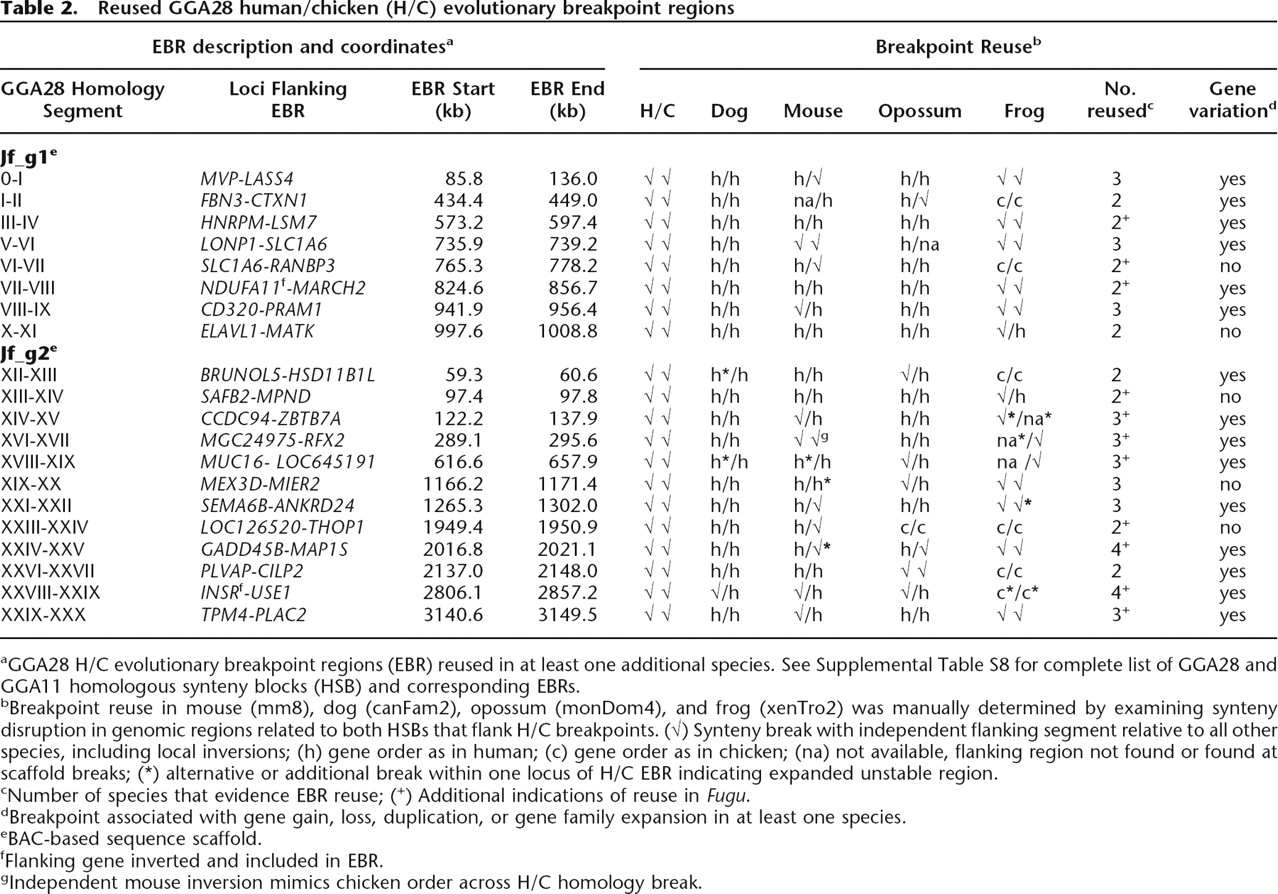
aGGA28 H/C evolutionary breakpoint regions (EBR) reused in at least one additional species. See Supplemental Table S8 for complete list of GGA28 and GGA11 homologous synteny blocks (HSB) and corresponding EBRs.
bBreakpoint reuse in mouse (mm8), dog (canFam2), opossum (monDom4), and frog (xenTro2) was manually determined by examining synteny disruption in genomic regions related to both HSBs that flank H/C breakpoints. (√) Synteny break with independent flanking segment relative to all other species, including local inversions; (h) gene order as in human; (c) gene order as in chicken; (na) not available, flanking region not found or found at scaffold breaks; (*) alternative or additional break within one locus of H/C EBR indicating expanded unstable region.
cNumber of species that evidence EBR reuse; (+) Additional indications of reuse in Fugu.
dBreakpoint associated with gene gain, loss, duplication, or gene family expansion in at least one species.
eBAC-based sequence scaffold.
fFlanking gene inverted and included in EBR.
gIndependent mouse inversion mimics chicken order across H/C homology break.



