


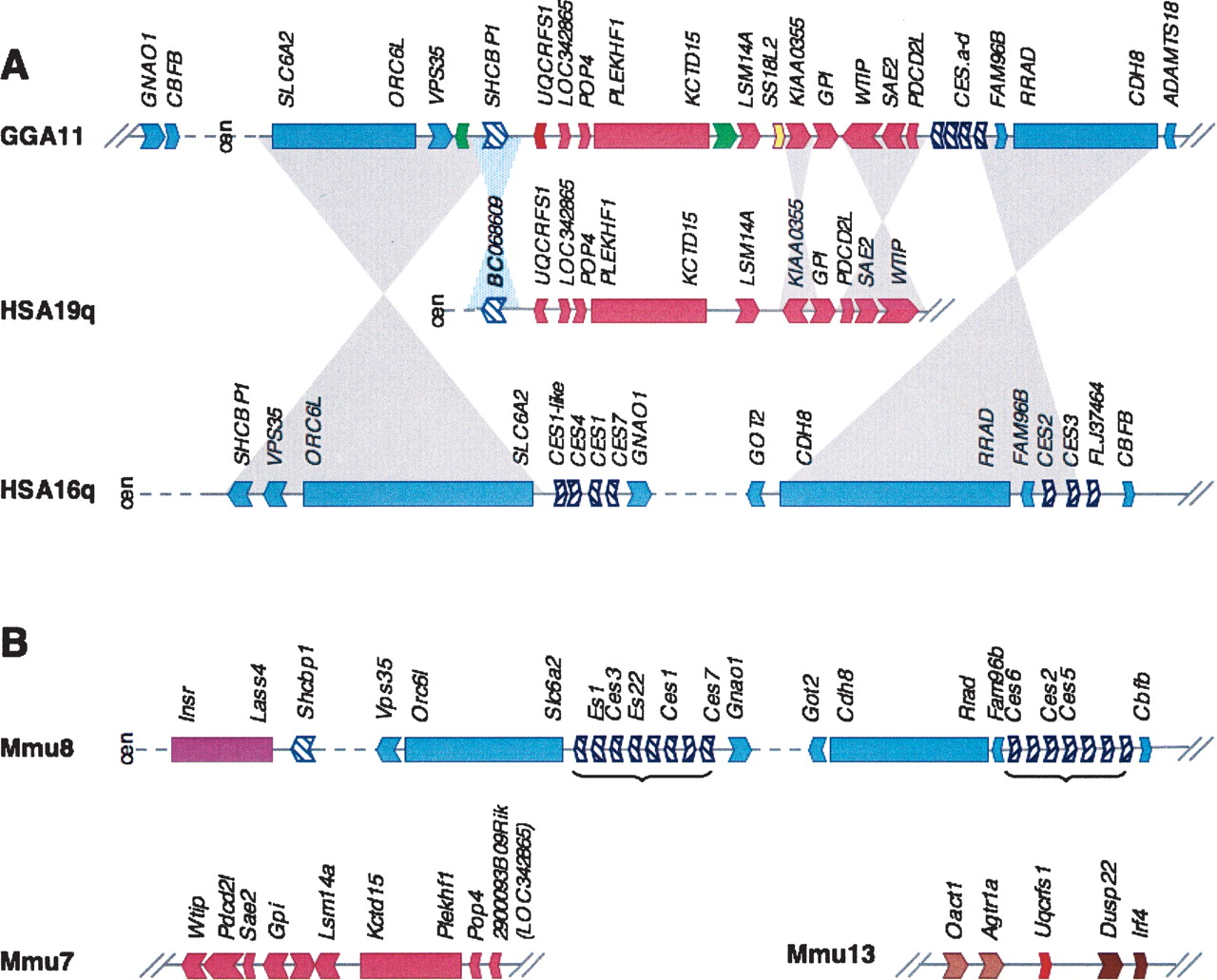
Evolutionary rearrangements distinguishing GGA11 and related regions in human and mouse. (A) Comparative organization of genes in GGA11 and homologous human regions. Complex series of gene duplication and inversion events mark the boundaries of the conserved HSA19q/GGA11 homology segment. Block arrows show orientation of individual genes: HSA16-related (light and dark blue); HSA19-related (light and dark red); unique chicken genes (green); HSA3 ortholog (yellow). Solid bars indicate long syntenic blocks with only anchor loci named. Duplicated genes associated with the evolutionary breakpoints between HSA16- and HSA19-related regions are hatched, e.g., a diverged HSA19 locus related to HSA16 locus SHCBP1 (light blue, hatched), and CES family members (dark blue, hatched). Gray-shaded areas link homologous regions found in inverted order between species; dashed lines denote regions of variable length between segments. Maps not drawn to scale. (B) Breakpoint reuse highlighted by alternate arrangements in the mouse genome. While many HSA19- and HSA16-related genes are similarly ordered in chicken, human, and mouse genomes (Mmu7, Mmu8, respectively), Shcbp1 and Uqcrfs1 have been inserted into alternate contexts in the rodent genome. HSA16q/GGA11 locus Shcbp1 has fused to another site of repeated breakpoint reuse, HSA19p/GGA28 ortholog Lass4 (lilac, Mmu8); in chicken LASS4 is flanked instead by the HSA16p11 locus MVP at the telomere of GGA28 (Table 2, Supplemental Fig. S2). Uqcrfs1 (dark red, Mmu13) is found between HSA6-related H/M HSBs (light and dark brown). The rodent CES gene family (brackets) has expanded dramatically to include at least 15 annotated loci.



