


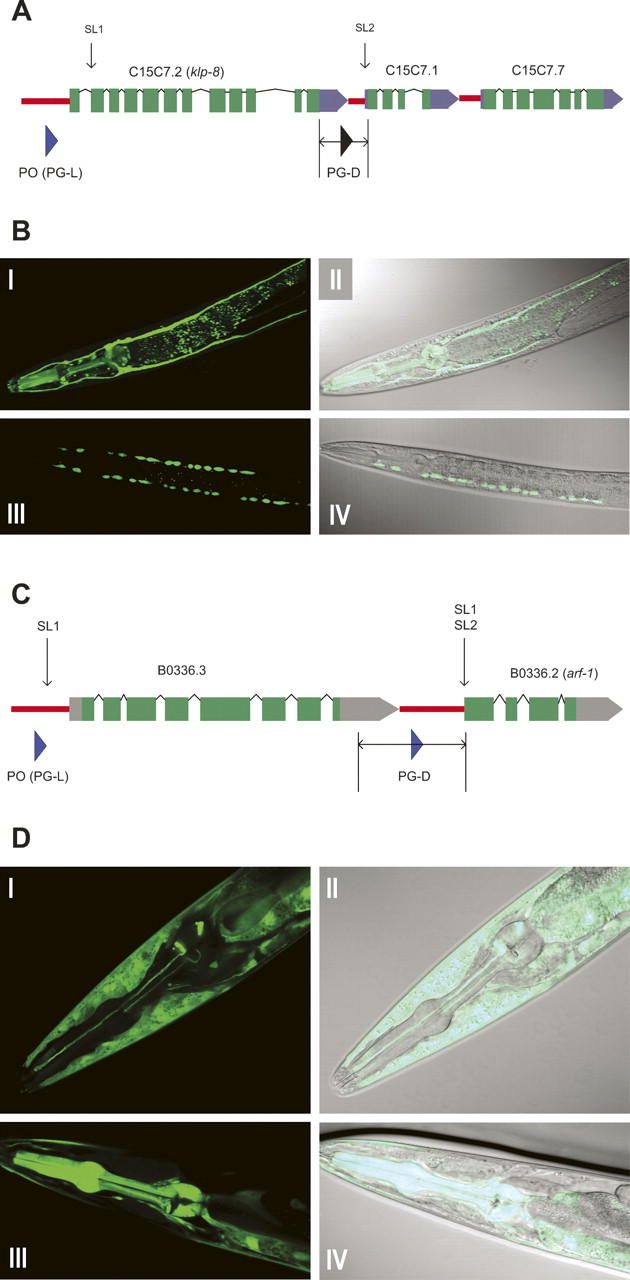
Schematic diagrams and expression patterns of the CEOPX040 (klp-8) operon and the CEOP3332 operon. (A) The klp-8 operon. Both the operon promoter (PG-L) for the leading gene C15C7.2 and the internal promoter (PG-D) for the downstream gene C15C7.1 have been extracted. (Green rectangles) Exons; (thin lines) introns; (thick red lines) intergenic regions; (gray areas) UTRs. (PO) The promoter of an operon; (PG-L) a promoter∷GFP constructed from the leading gene of an operon; (PG-D) a promoter∷GFP constructed from the corresponding operon downstream gene. (B) I and II show that the promoter extracted from leading gene C15C7.2 is able to drive GFP expression in the excretory cell, pharynx, pharyngeal neurons, and head neurons, while the promoter extracted from downstream gene C15C7.1 directs GFP expression in the seam cells (III and IV). (C) The CEOP3332 operon. Both the operon promoter and the internal promoter for downstream gene B0336.2 are used to construct GFP fusions. (D) I and II show that the promoter extracted from leading gene B0336.3 is able to drive GFP expression in hypodermis, pharyngeal gland cell, gut, and nerve ring, while that of downstream gene B0336.2 is able to drive GFP expression in the pharynx, gut, and head neurons (III and IV).



