


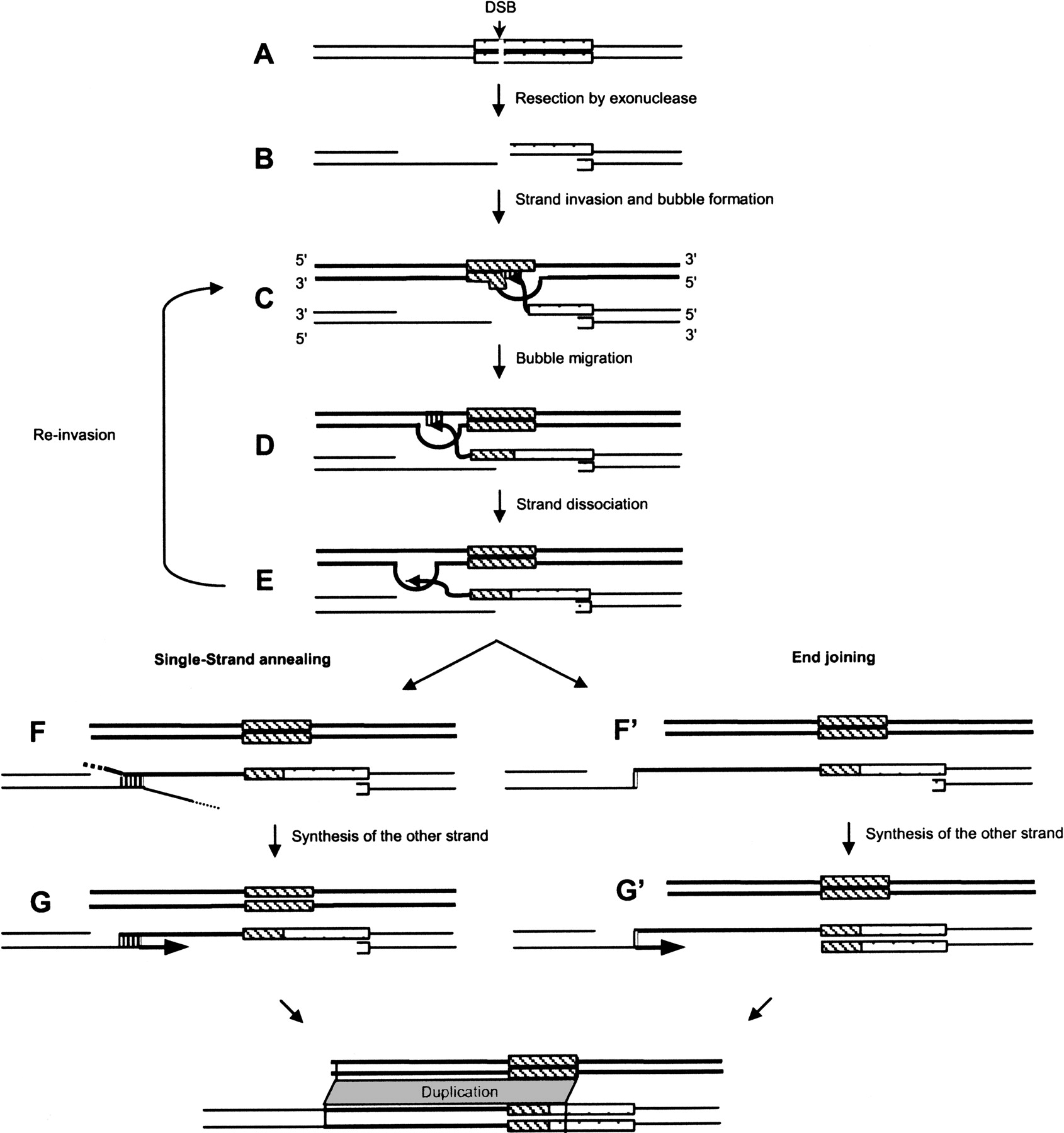
DDSA model. Repeat copies are represented by boxes. (A) DSB occurs in a repeat. (B) Exonuclease digestion exposes a repeated sequence at one 3′ free extremity. (C) Homologous base-pairing with another copy of the same repeat induces bubble formation—i.e., protein complex. (D) Bubble migration proceeds along the donor DNA template. (E) Newly synthesized strand is dissociated from the template duplex to return to the broken molecule. The newly synthesized strand can also re-invade the same template. The DNA repair process can finish through single-strand annealing (F) or end-joining (F′) pathways, then initiating the repair of the second strand using the newly synthesized strand as template. (G) According to the single-strand annealing process, the annealing is obtained from a short homology. (G′) In the end-joining pathway, a microhomology could be sufficient. At the end of the duplication process and in both pathways, the repeat and the contiguous region of the repeat are duplicated into the break. Note that this figure illustrates only unidirectional synthesis, whereas in the SDSA model, bidirectional synthesis can occur if both ends present a repeat.



