


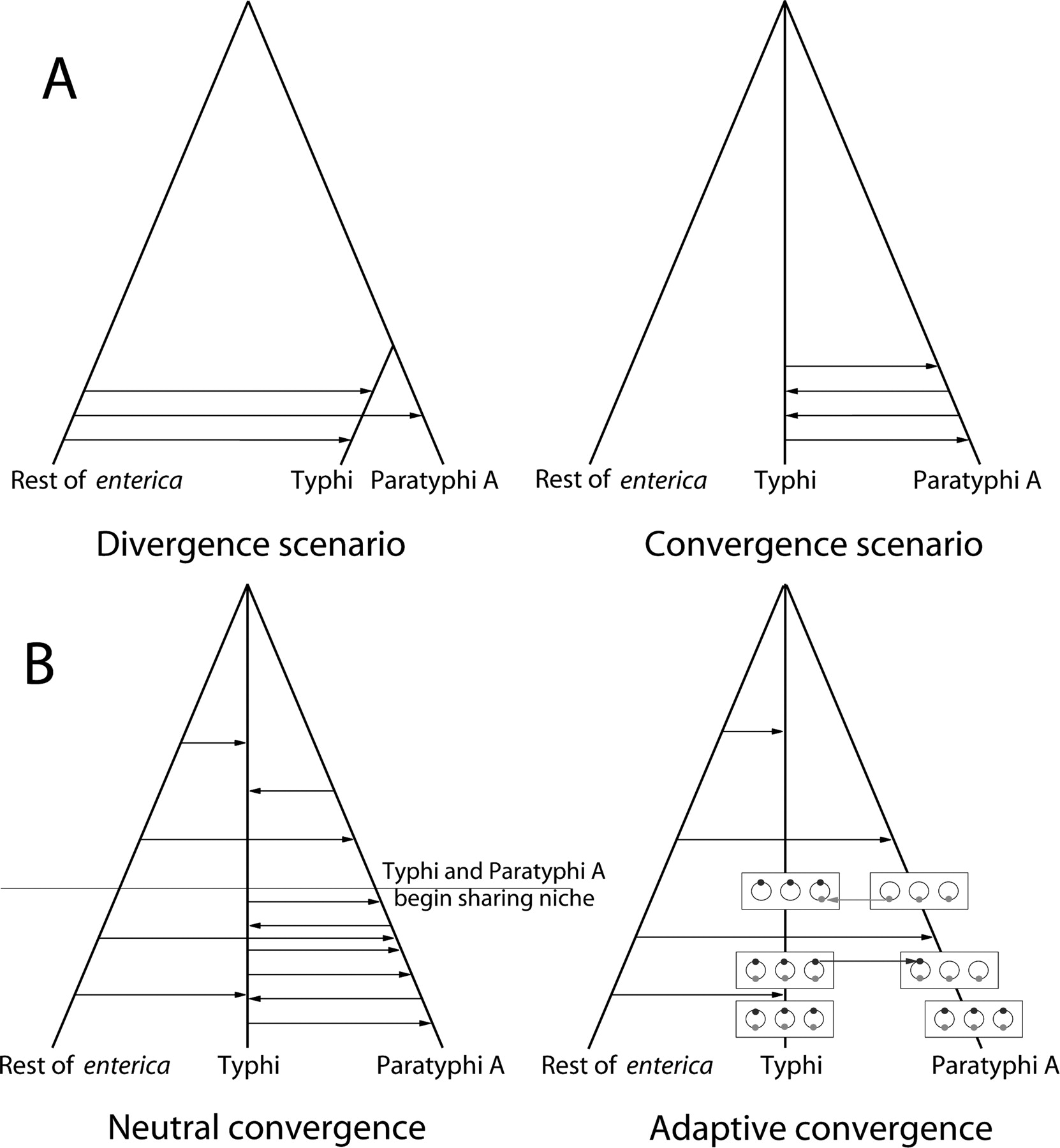
Figure 4.
Scenarios for the divergence of Typhi and Paratyphi A. The trees indicate the clonal history and the arrows indicate genetic exchange events. (A) Illustration of the two scenarios that can explain the bimodal distribution of divergence levels (Fig. 1D). (B) Illustration of the two convergence factors. Under neutral convergence, the two lineages converge due to an elevated rate of exchange between them. Under adaptive convergence, exchanges between the two lineages are preferentially fixed because they contain alleles (gray dots), which confer a selective advantage in their common niche.



