


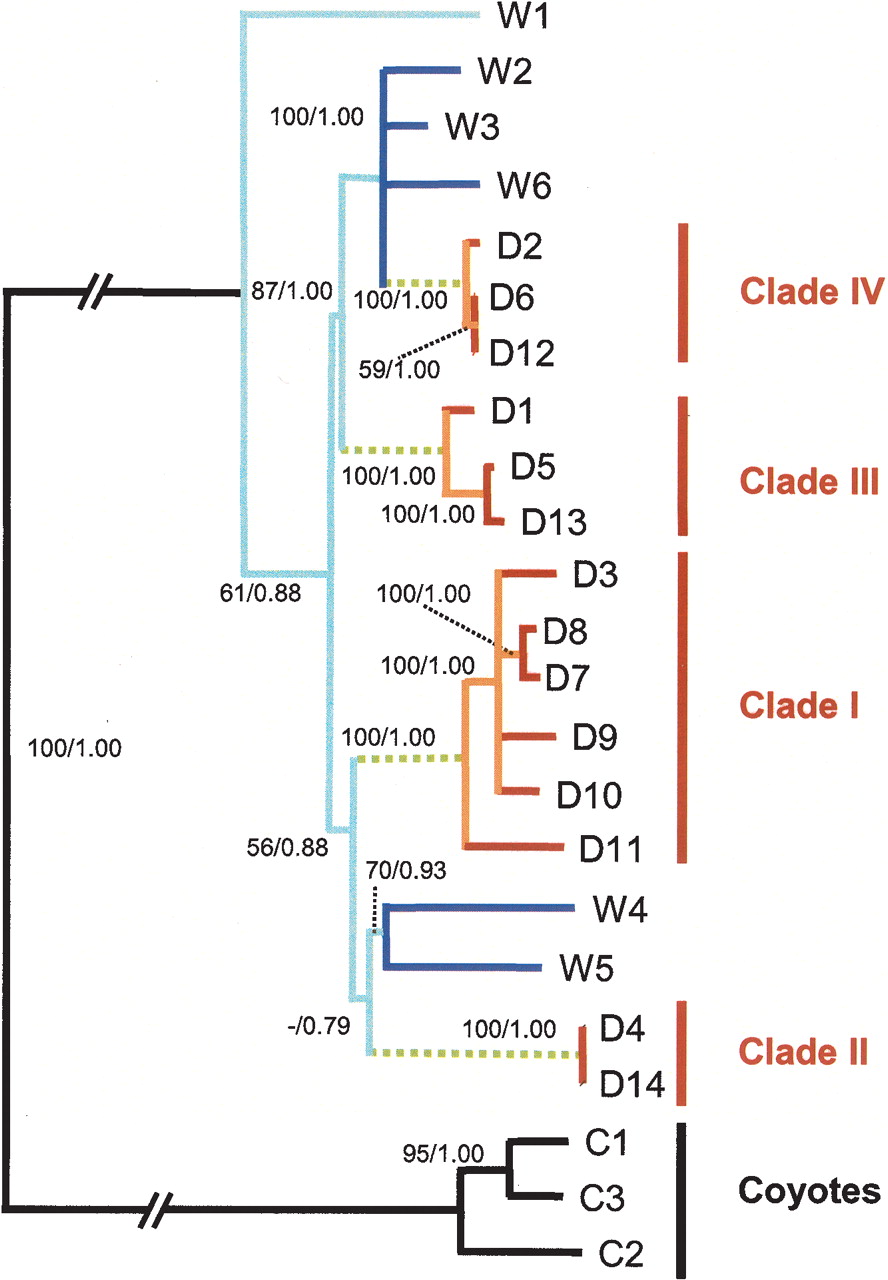
Phylogenetic tree of wolf (W), dog (D), and coyote (C) mtDNA sequences. The tree was constructed using a Bayesian approach. The same topology was obtained with a neighbor-joining approach. Support is indicated at the nodes as percent bootstrap support for 1000 neighbor-joining replicates and Bayesian posterior probabilities. Four clades of dog sequences (I to IV) are indicated as in Vilà et al. (1997). Internal dog branches are marked in orange, and internal wolf branches are marked in light blue. The branch leading to wolf haplotype W1 was basal to the rest of the tree and it was also considered internal. Internal branches that could not be conclusively associated to dogs or to wolves are indicated in discontinuous green.



