


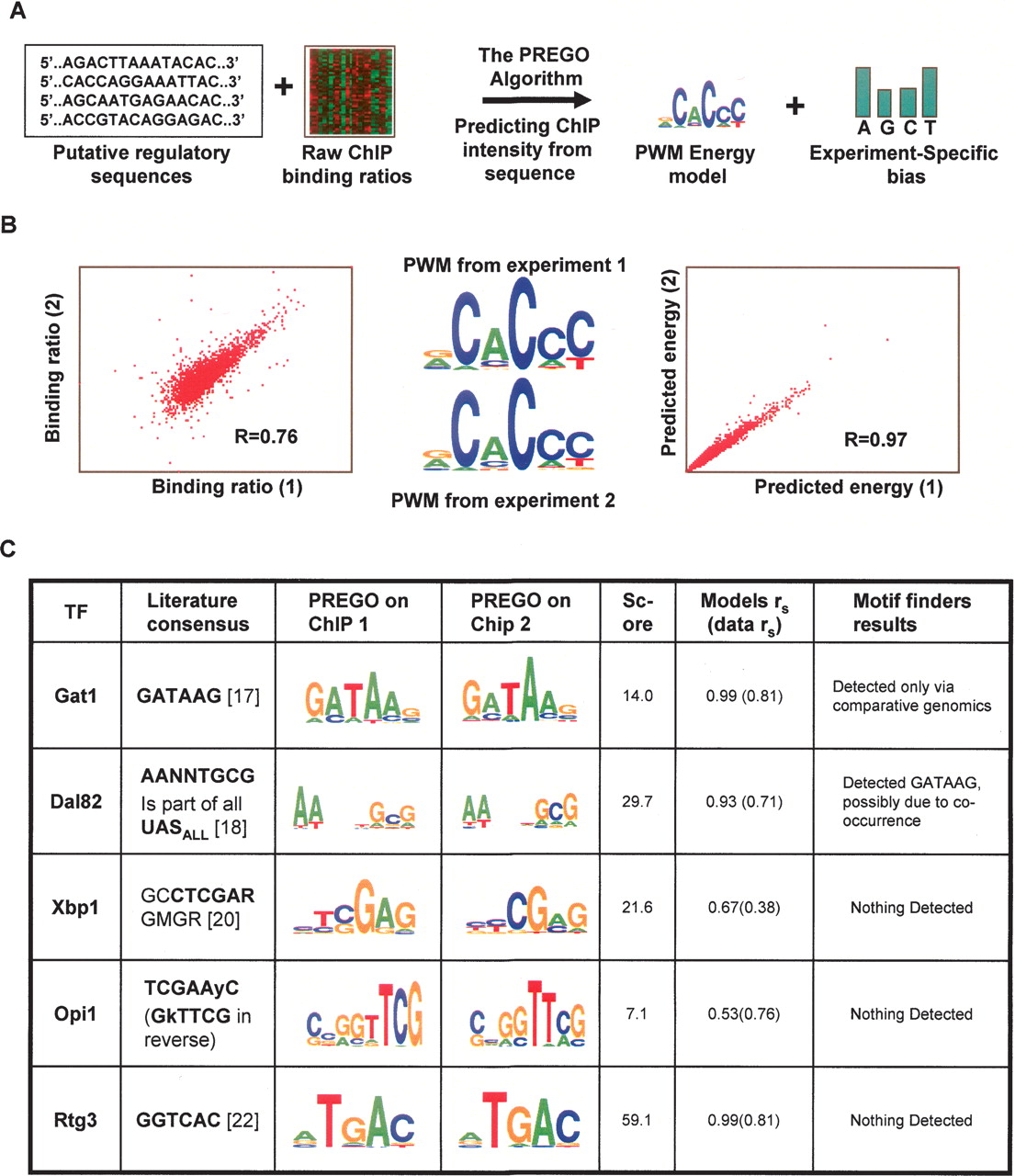
Motif regression reveals known and novel binding sites. (A) The PREGO algorithm. The PREGO algorithm was developed to fit PWM models to raw ChIP-on-chip profiles. The algorithm combines ChIP and sequence data and builds PWM models with optimal prediction accuracy over the entire affinity spectrum. (B) Robustness of PWM energy predictions. Applying the PREGO algorithm independently to individual experiments demonstrates the robustness of the derived energy models. Shown here is the correlation between two Aft2 experiments (left), the two PWM models derived from them (middle), and the correlation of the energy predictions for these two PWMs. The remarkable reproducibility suggests that PREGO-derived PWMs may be used quantitatively. (C) Using low-affinity promoters improves motif-finding sensitivity. Shown are examples of PWMs inferred by the PREGO algorithm from ChIP profiles in which the motif-finding approach failed to find motifs. All the cases shown are confirmed by additional evidence from the literature. See Methods for definition of the PWMs score. “Models rs” represents the Spearman correlation of energy predictions from PWMs generated using two different arrays. “Data rs” represents the Spearman correlation of the two raw ChIP profiles used to construct the two PWMs.



