


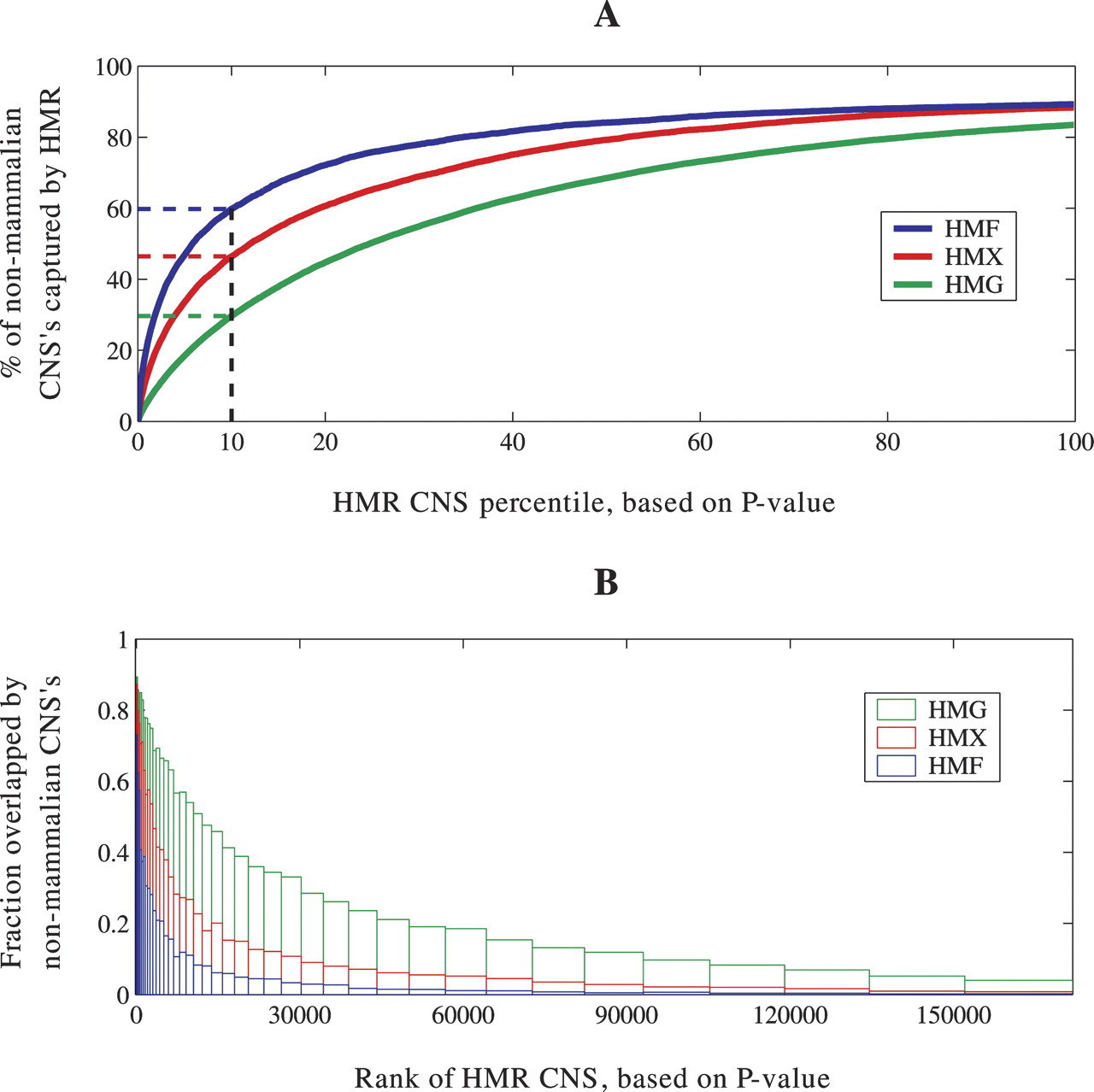
Whole-genome noncoding conservation and the funnel principle: strong enrichment for nonmammalian conservation in top-ranked (lowest-P-value) human–mouse–rat CNSs. (A) Cumulative fraction of nonmammalian CNSs overlapped by various quantiles of human–mouse–rat CNSs. The top 10% of human–rodent CNSs (by P-value) constitute a set of 17,185 sequences with a high degree of recent evolutionary conservation, that encompass 60% of whole-genome human–mouse–fish CNSs, 46% of human–mouse–frog CNSs, and 30% of human–mouse–chicken CNSs. (B) The 171,853 human–rodent CNSs are binned by P-value. Vertical bars represent the fraction of human–rodent CNSs in each bin that overlap more ancient CNSs.



