


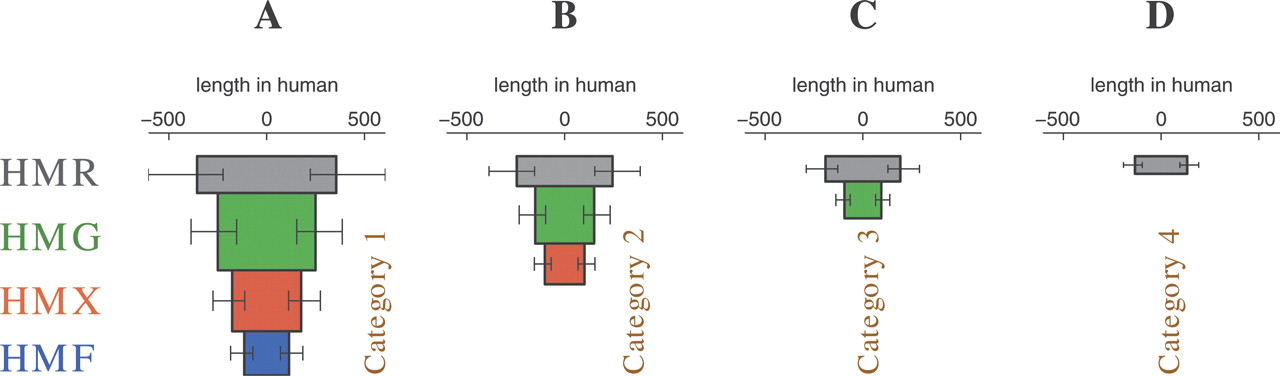
Whole-genome noncoding conservation and the funnel principle: correlation between ancient and recent noncoding conservation (funnel principle), illustrated by four evolutionary stacking patterns (ESPs). HMR/G/X/F: human–mouse–rat/chicken/frog/fish. The four ESPs depict four sets of whole-genome HMR CNS, categorized by their most ancient overlapping nonmammalian CNS. Stacked below the rectangular blocks representing HMR CNSs are blocks depicting the corresponding ancient CNSs. (A) Category 1 CNSs extend to HMF, (B) Category 2 to HMX, (C) Category 3 to HMG, and (D) Category 4 is limited to HMR. Block width is proportional to median CNS length in human, and block area is proportional to the median of −log(P-value). Block height thus represents degree of evolutionary constraint at the basepair level. Error bars mark the range from the 25th to the 75th percentile of CNS length. The funnel principle takes its name from the funnel-like shape of ESPs.



