


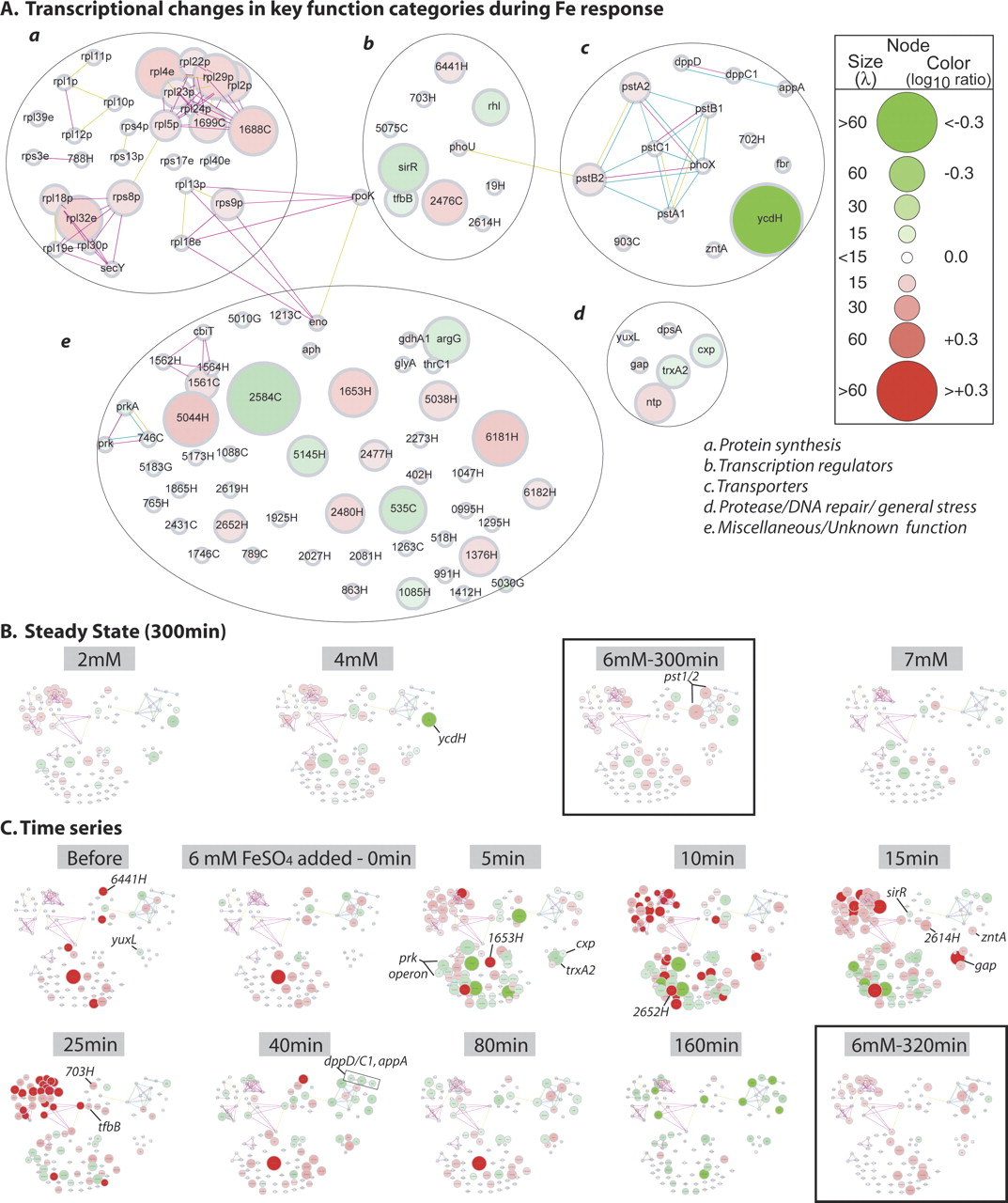
Dose and time dependence of response to Fe. (A) Steady-state response to 4 mM Fe(II) is used to describe the layout of this figure—use this as a key while viewing B and C. Genes of key function categories (a–e; see inset key) that experienced mRNA level changes in a dose and/or time-dependent manner to Fe(II). Genes are indicated as circular nodes connected by three types of functional associations: operon (pink), chromosomal proximity (green), and phylogenetic pattern (blue). Red shading of nodes indicates increased mRNA and green shading denotes decreased mRNA concentration relative to concentrations in a standard reference RNA sample (see inset key). (B) Transcript level changes at 300 min in four concentrations of FeSO4. Relative mRNA levels were measured subsequent to 300-min exposure at 37°C (220 rpm shaking) of mid-logarithmic growth phase halobacterial cultures to 2, 4, 6, or 7 mM FeSO4. (C) Time-course mRNA level changes during response to Fe stress. A continuous culture of Halobacterium NRC-1 was subjected to sudden exposure to 6 mM FeSO4. mRNA levels were measured by microarray analysis just prior to addition of FeSO4 and over a nine-point time course up until 320 min.



