


Cover image
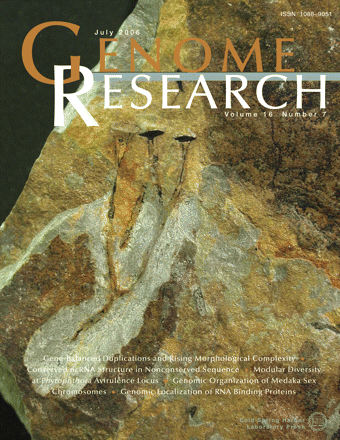
Cover A fossil of Cooksonia pertoni, one of the earliest land plants, was found in Shropshire, England. Although Cooksonia were only a few centimeters tall and did not have leaves, flowers, or seeds, its dichotomously branching stems tipped in sporangia made it one of the most morphologically complex land plants during the Upper Silurian, ~410–420 million years ago. This illustrates that the maximums of plant morphological complexity—represented by present-day Angiosperms such as daisies and orchids—have certainly increased over time. In this issue, Freeling and Thomas show that repeated tetraploidies along the plant lineage help to explain this rising trend in morphological complexity. By analyzing the consequences of the most recent tetraploidy in the Arabidopsis lineage, Thomas et al. supply some details on how tetraploidy naturally leads to chromosomal clusters of dose-sensitive genes. (Photo and fossil: Hans Steur, The Netherlands. [For details, see Freeling and Thomas, pp. 805–814 and Thomas et al., pp. 934–946.])

