


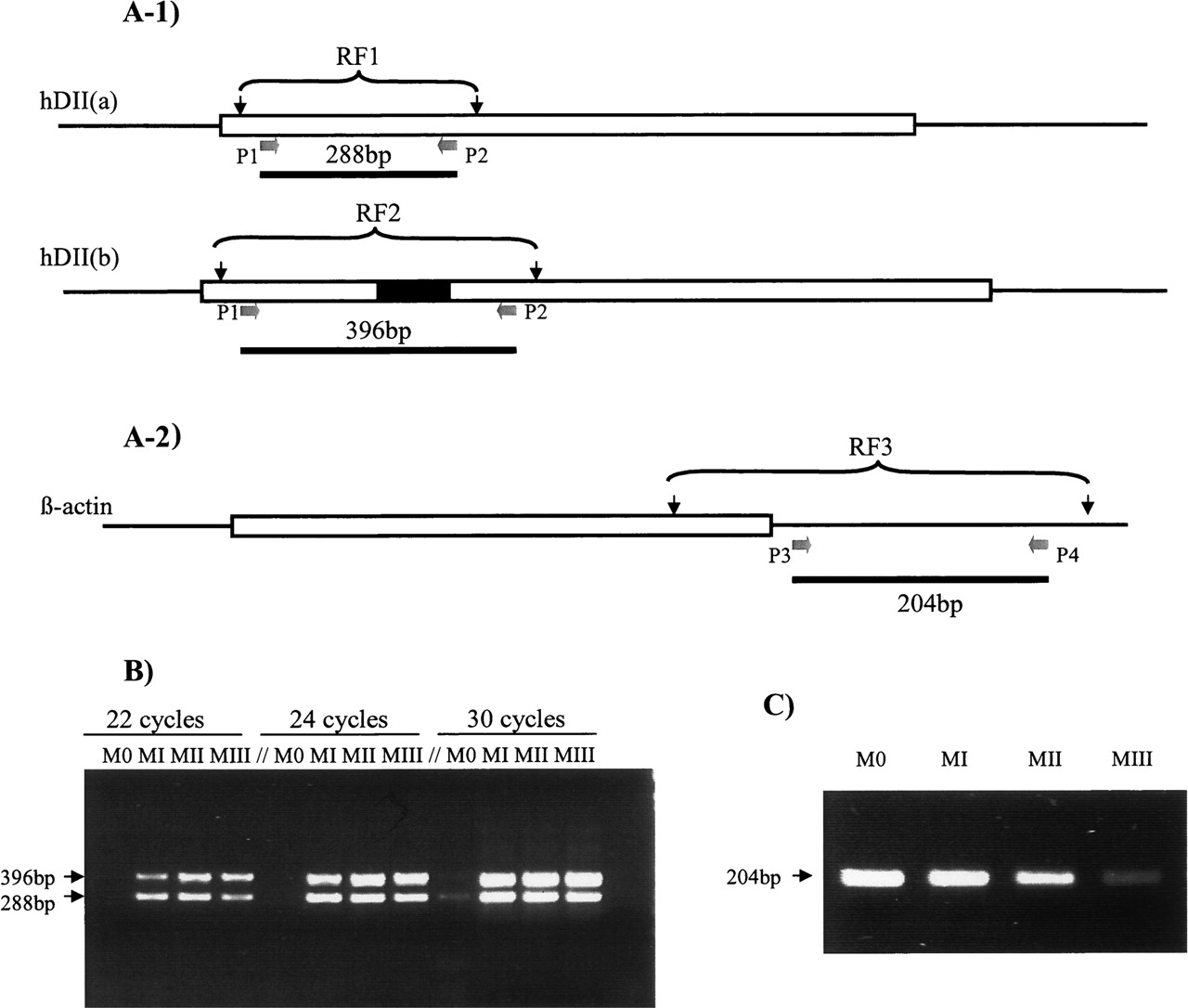
Experimental assessment of enrichment in AS events. (A) schematic representation of (1) hDII(a) and hDII(b) cDNAs, the two variants of the human type II iodothyronine deionidase gene generated by an alternative splicing event occurring in human placenta (Ohba et al. 2001); (2) the β-actin cDNA. Black vertical arrows show the RsaI restriction sites whose cleavage produces the restriction fragments (RF1, RF2, and RF3) that were monitored by PCR in the M0, MI, MII, and MIII mixtures (see below). Primer positions for PCR are indicated by gray horizontal arrows, and amplification products are indicated by bars. hDII(b) differs from hDII(a) by an additional 108-nt-long exon (black box). (B) PCR assessment of the relative abundance within the M0, MI, MII, and MIII mixtures of the two hDII restriction fragments RF1 and RF2. Four PCR reactions were performed with 4 ng of template DNA from the M0, MI, MII, and MIII mixtures using primers P1 and P2. Six-microliter aliquots were taken from the PCR reactions after 22, 24, and 30 amplification cycles and electrophoresed in a 1.2% agarose gel. Two PCR products of the expected size were amplified. Densitometry revealed a 30-fold increase in these products in lanes MI, MII, and MIII relative to M0. (C) PCR assessment of the relative abundance within the M0, MI, MII, and MIII mixtures of the β-actin restriction fragments RF3. Four PCR reactions were performed with 4 ng of template DNA from the M0, MI, MII, and MIII mixtures using primers P3 and P4. Eight-microliter aliquots were taken from the PCR reactions after 22 amplification cycles and electrophoresed in a 1.2% agarose gel. A PCR product of the expected size was amplified, and densitometry revealed that its abundance decreased ∼15%, 50%, and 90% in MI, MII, and MIII relative to M0.


