


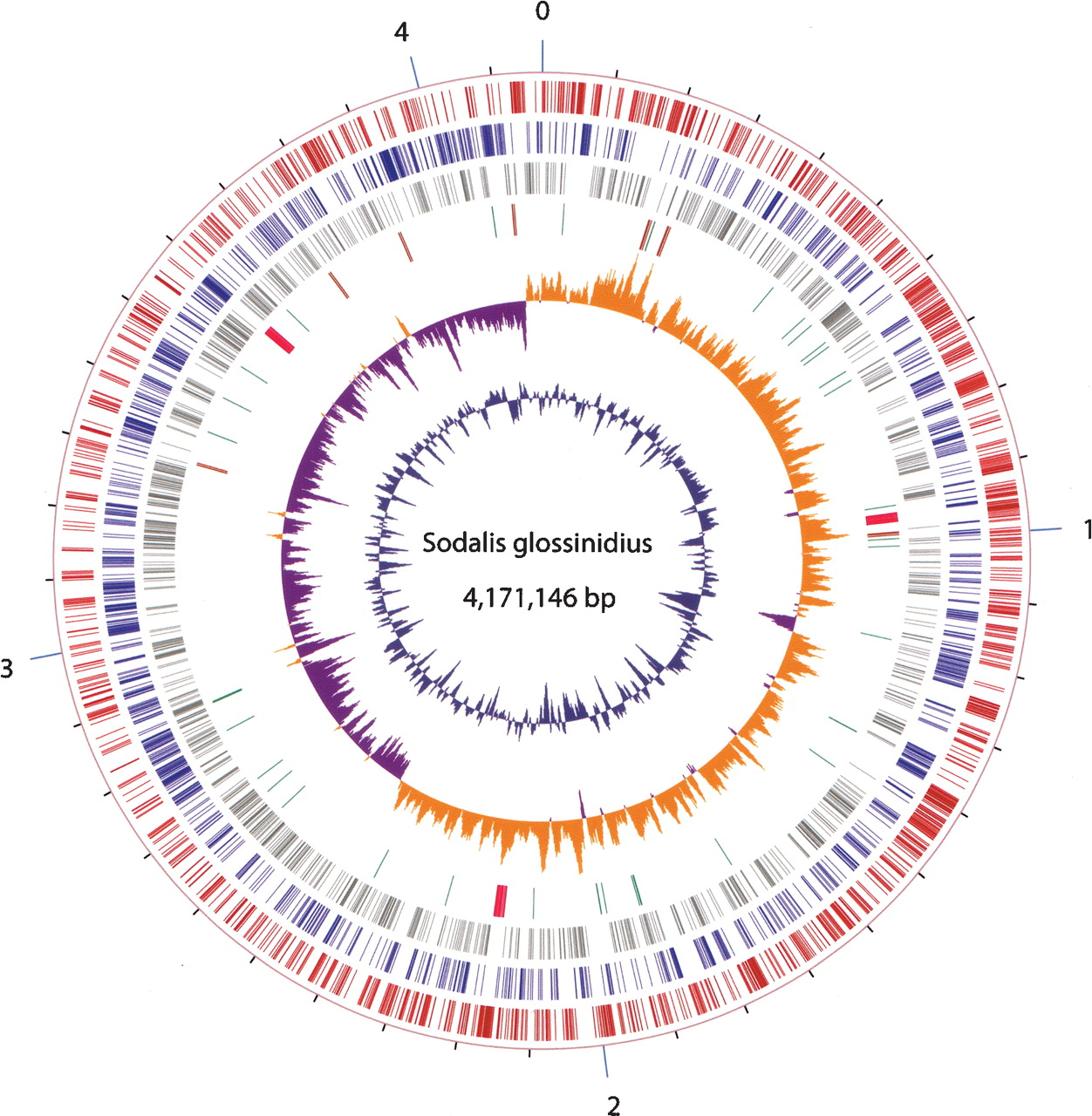
Figure 1.
Circular representation of the Sodalis glossinidius chromosome. The outer scale (indicated by numbers 1–4) is shown in megabases. From the outside in: circle 1, positive strand CDSs (red); circle 2, negative strand CDSs (blue); circle 3, pseudogenes (gray); circle 4, tRNA genes (green), rRNA genes (brown), genes for type III secretion systems (pink); circle 5, GC skew ([G-C]/[G+C]; khaki indicates values >0; purple indicates values <0); and circle 6, G+C content (higher values outward).


