


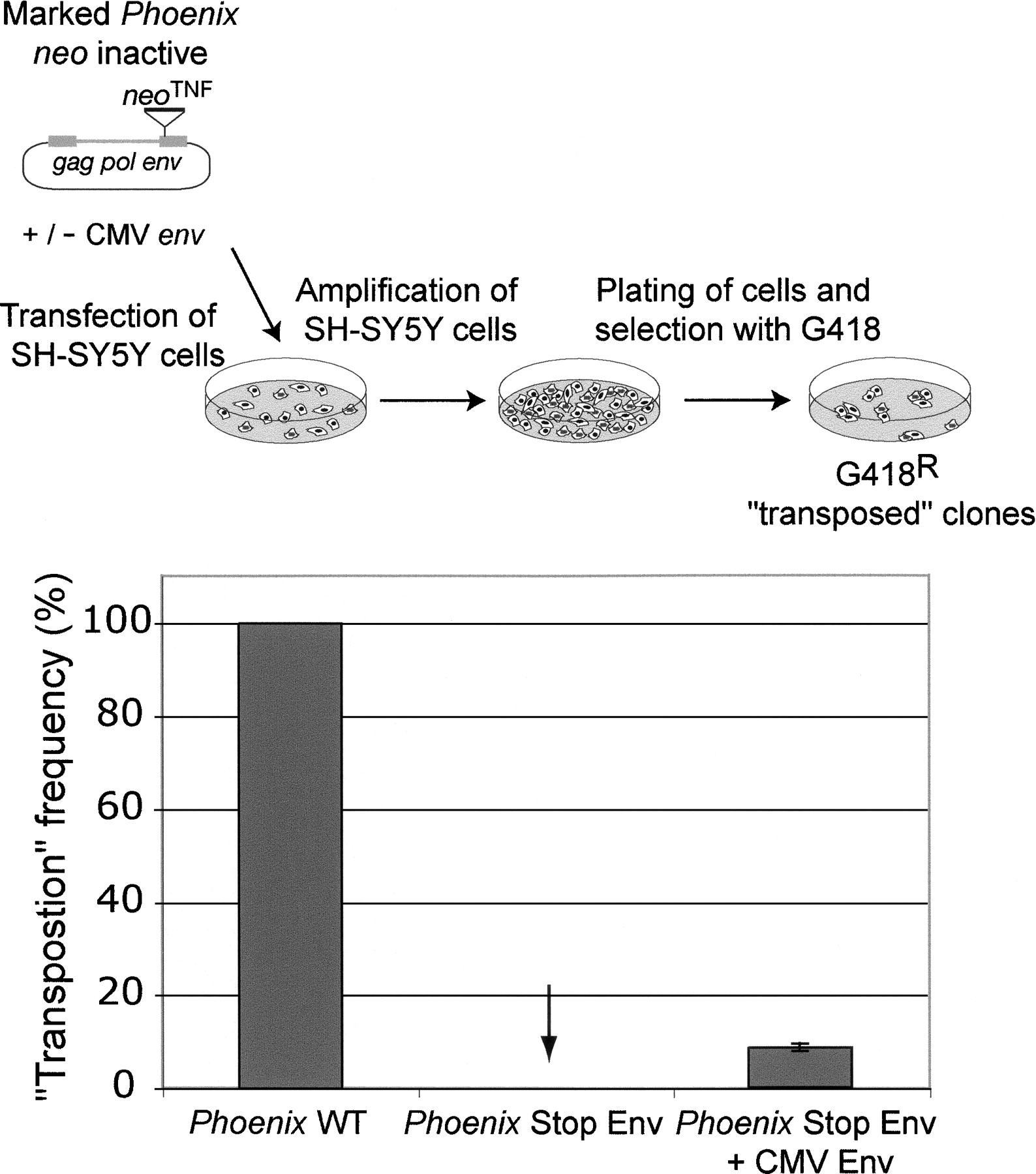
Assay for Phoenix “retrotransposition.” (Top) Rationale of the assay. Phoenix was marked with the neoTNF indicator gene for retrotransposition (Esnault et al. 2002), in which neo becomes active only after a complete retrotransposition cycle (i.e., transcription, reverse transcription, and integration), and the marked element was introduced by transfection into SH-SY5Y human cells permissive for Phoenix infection. The cells were then amplified and subjected to G418 selection for 2 wk; the number of G418R clones (several of which were assayed by PCR to demonstrate splicing out of the intron within the neo indicator gene) yielded the frequency of retrotransposition of the marked elements. (Bottom) “Retrotransposition” is dependent on the presence of a functional env gene, either present within the native Phoenix provirus (Phoenix WT) or added in trans to an env-mutated Phoenix provirus (Phoenix Stop Env) by cotransfection of the cells with an env expression vector (CMV Env). The results presented here correspond to three independent experiments, performed with 5–10 × 106 cells, and are given as relative transposition frequencies as compared to neoTNF-marked Phoenix (whose transposition frequency is 2 × 10⁻⁵ clone/seeded cell under these conditions).



