


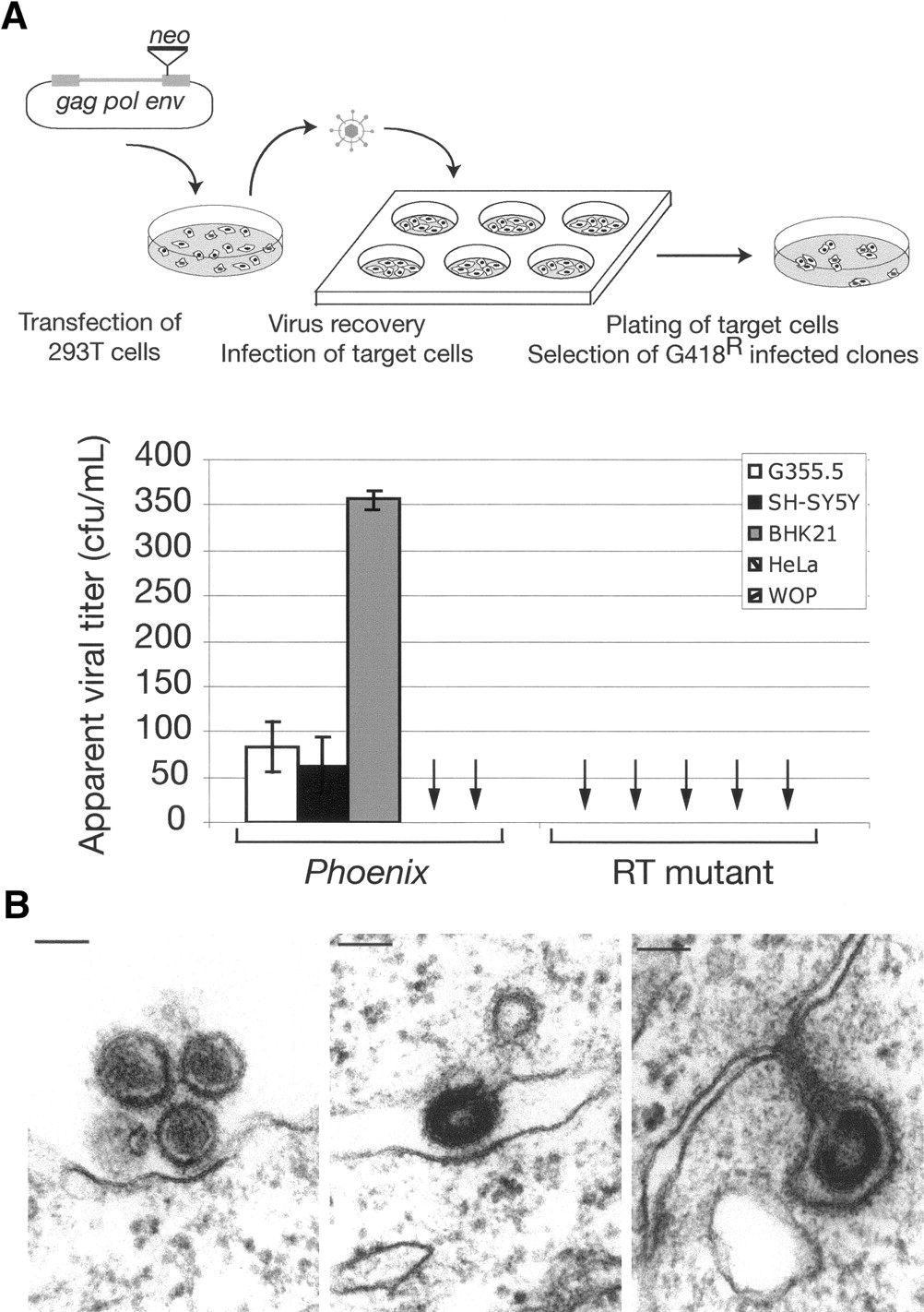
Infectious properties of Phoenix encoded particles. (A) Infectivity of the HERV-K retroviral particles. The apparent viral titer observed with the neo-marked HERV-K(HML2) provirus is indicated for a panel of target cell lines (the quantitative results for the 293 cell line is not shown since their restricted adherence impaired the proper quantification of individual G418R clones), together with that obtained with a mutant for the RT domain tested in the same conditions (no clone observed); data are the results from three to eight independent experiments, with the standard deviation indicated. The other mutants (gag, pro, and env) gave the same, negative, results when assayed, with no clone observed in three independent experiments (difference measured between Phoenix WT and mutants significant with P <0.001 for G355.5 and BHK21 cells and P <0.01 for SH-SY5Y cells, Student’s t-test). The rationale of the assay is schematized at top. (B) Infection of cells by Phoenix particles. On the left, two mature particles appear to interact with the cell membrane of the closest cell, with a thickening of the membrane at the exact point of interaction with the particle. In the middle and on the right, two images suggestive of a cell-to-cell infection are presented, with a particle still budding from its progenitor cell already in contact with the neighboring cell.



