


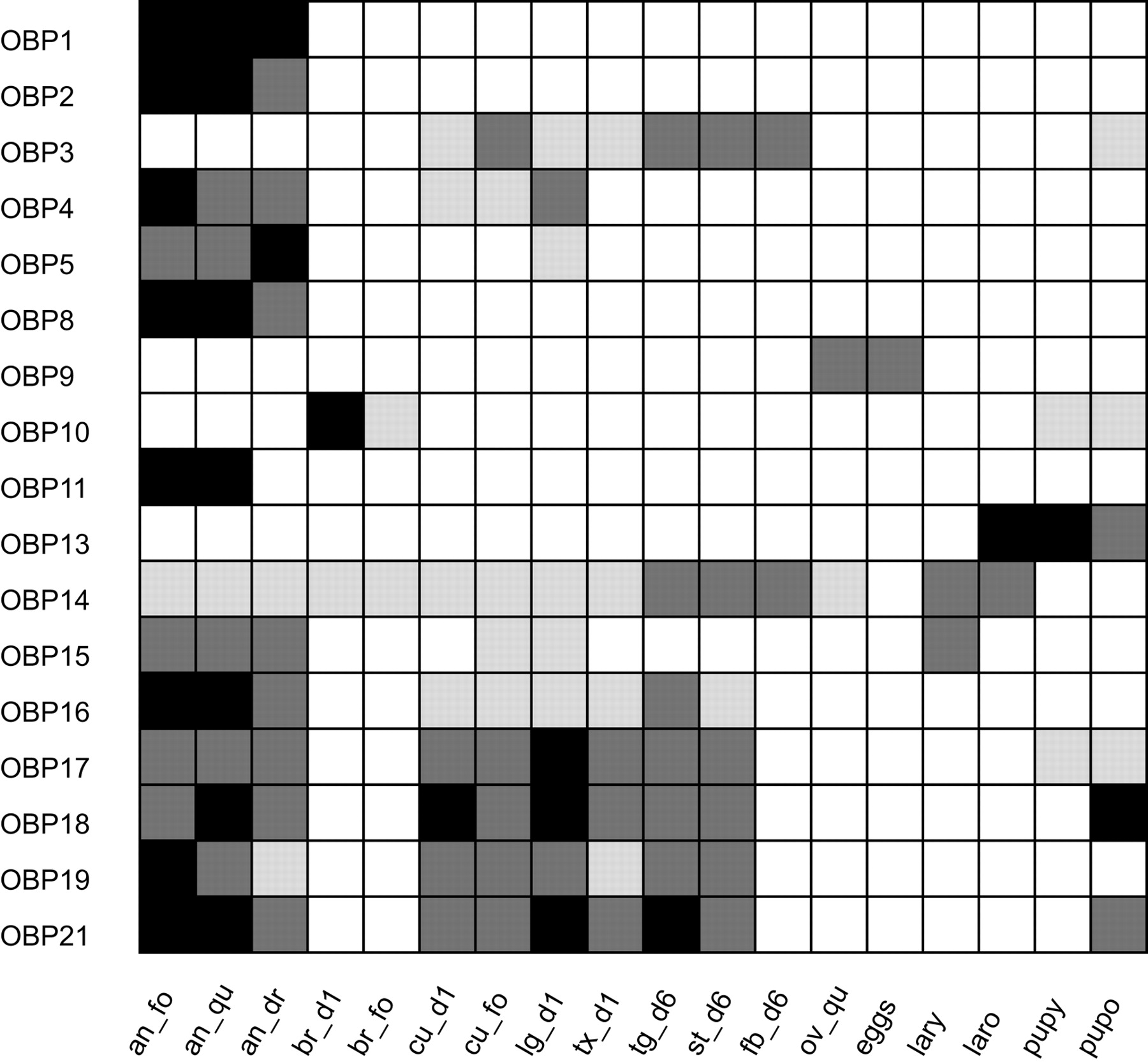
Global expression patterns of Apis mellifera OBPs. The levels of expression are illustrated by three grades of grayscale relative to the ribosomal protein S8: Light gray indicates low level of expression defined as more than 2× background and less than half of the S8 level; dark gray indicates medium level of expression (between half and twice the level of S8), and black stands for high level of expression defined as more than 2× the level of S8. The expression of S8 was always more than 2× the background value. OBPs are shown on the y-axis and the examined tissues on the x-axis: an_fo, forager antennae; an_qu, queen antennae; an_dr, drone antennae; br_d1, newly emerged bee brain; br_fo, forager brain; cu_d1, newly emerged bee head's cuticle; cu_fo, forager head's cuticle; lg_d1, newly emerged bee legs; tx_d1, newly emerged bee thorax; tg_d6, 6-d-old bee tergites; st_d6, 6-d-old bee sternites; fb_d6, 6-d-old bee fat bodies; ov_qu, queen ovaries; eggs, eggs; lary, young larvae, stage 1 and 2; laro, old larvae, stage 5; pupy, young pupae, white-eyed; pupo, old pupae, dark-eyed.



