


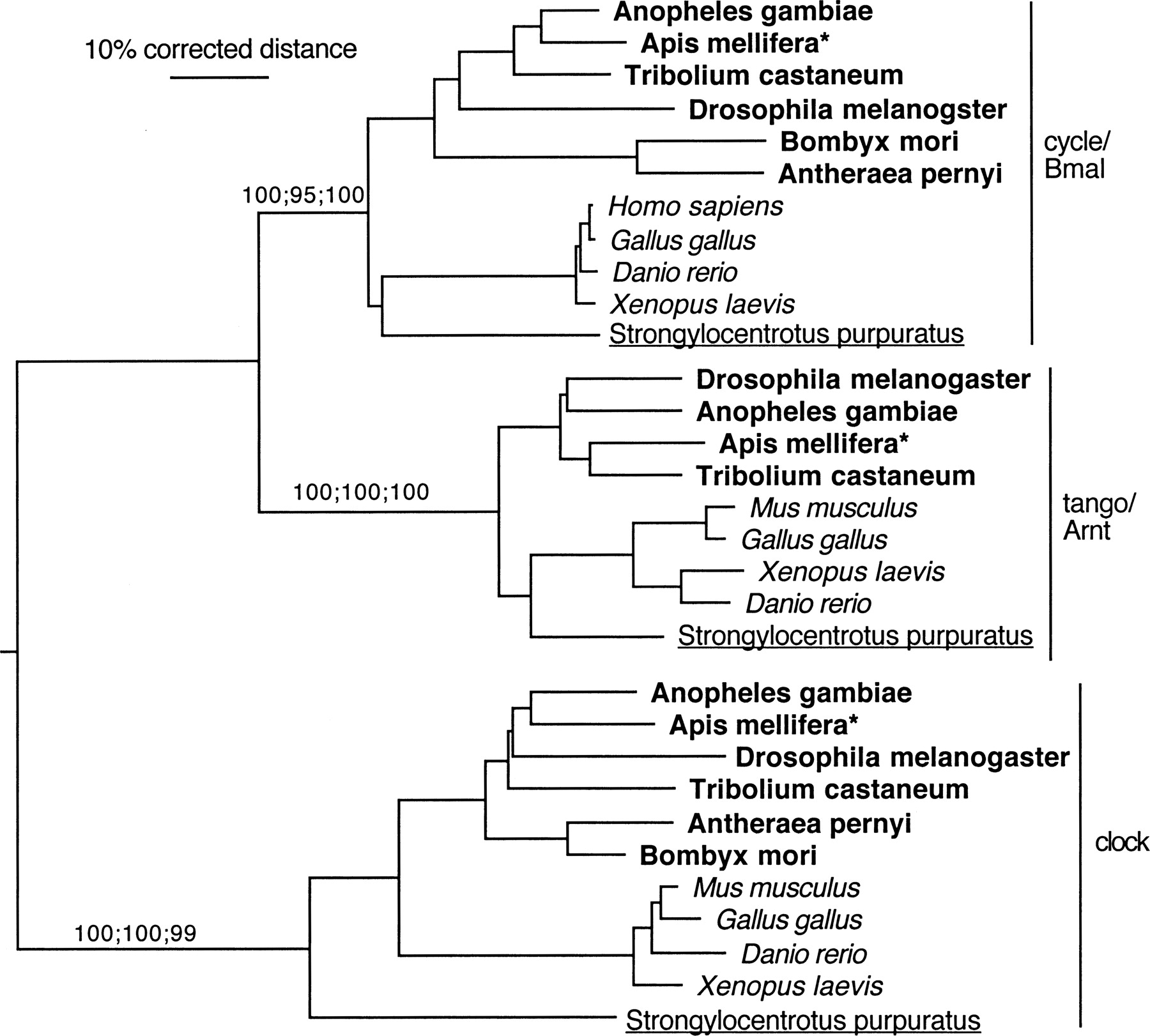
Phylogenetic relationships of the Cycle/Bmal, Tango/Arnt, and Clock protein family. We used the Clock protein as an outgroup to root the tree based on its divergence from the Cycle/Bmal and Tango/Arnt sister proteins. Support levels are shown only for the main protein lineages, which are separated slightly vertically for visual clarity (percentage of trees showing a branch in distance and parsimony bootstrapping, followed by percentage of maximum likelihood quartet puzzling steps). Distinct font styles are used to highlight major taxonomic lineages. Bold for insects, italics for vertebrates, underline for the sea urchin, and plain for all the others. The honey bee Apis mellifera is highlighted with an asterisk.



