


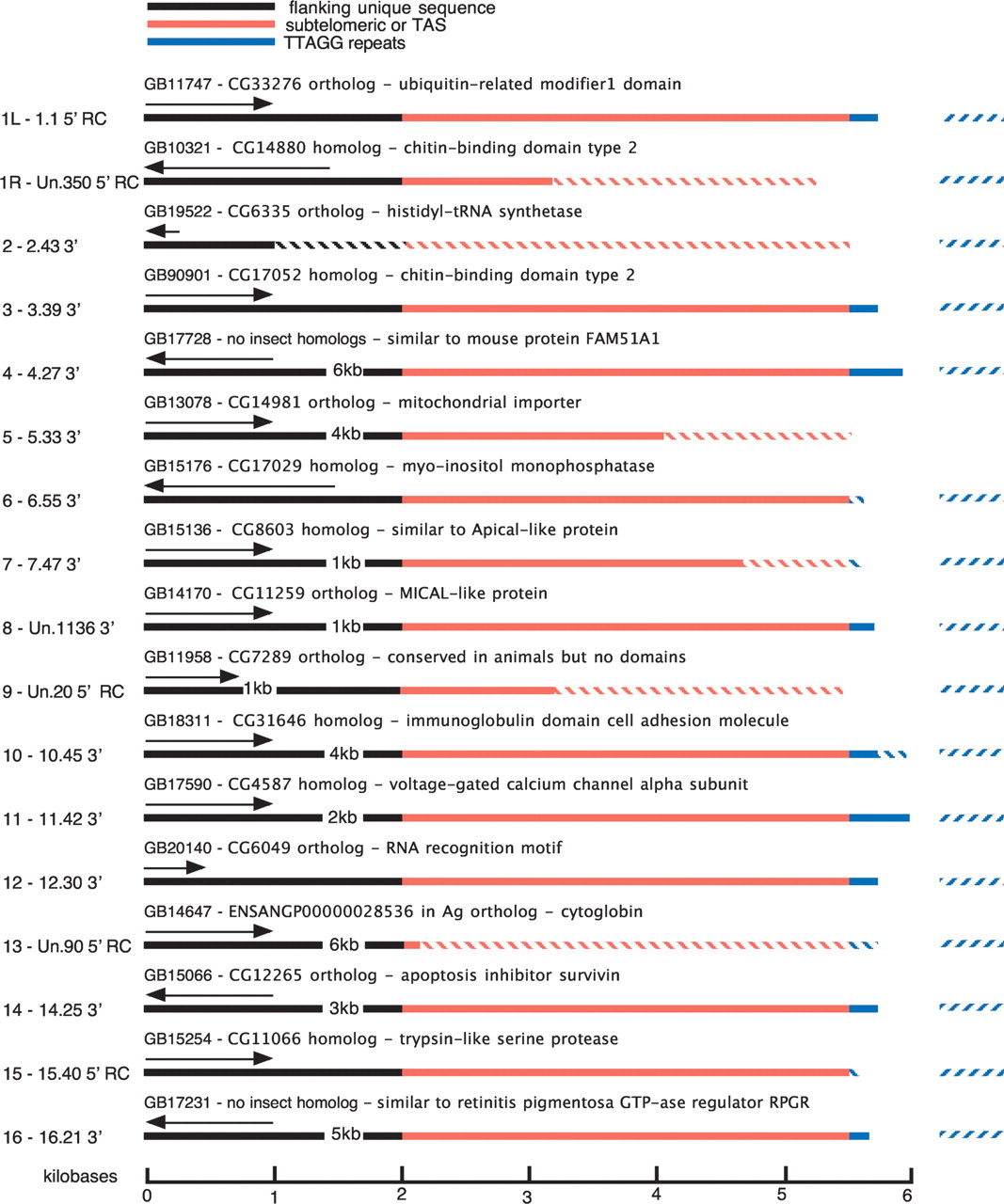
Schematic diagram of the 17 distal honey bee telomeres. Flanking unique DNA sequence is shown as black bars, the subtelomeric sequence is red, and the TTAGG or variant tandem telomeric repeats are blue. Length variation in the subtelomeric sequence (from 3–4 kb) is not shown. Hatched lines indicate regions that were manually assembled. The existence of clone end mate pairs that indicate extensive TTAGG repeats beyond the assembled ends of the chromosomes are indicated on the right as separate hatched blue bars. Each chromosome is identified on the left, together with the identifier of the terminal scaffold in the format GroupX.Y, where X is the chromosome number or Un for unmapped scaffolds, and Y is the scaffold number on that chromosome or in the unmapped grouping. Above each chromosome bar the approximate location and orientation of the ultimate gene is shown by an arrow (if the gene model starts or ends more than 1.5 kb from the subtelomeric sequence the extra length is shown interupting the black bar). The genes are identified by the GB number in the “official” and “ab initio” gene prediction sets (Honey Bee Genome Sequencing Consortium 2006), as well as their best BLASTP match in Drosophila melanogaster, or other organisms if the Drosophila ortholog has been lost (three genes) and their likely function is shown by similarity to mammalian proteins or any conserved domains shown by the NCBI Conserved Domain search.



