


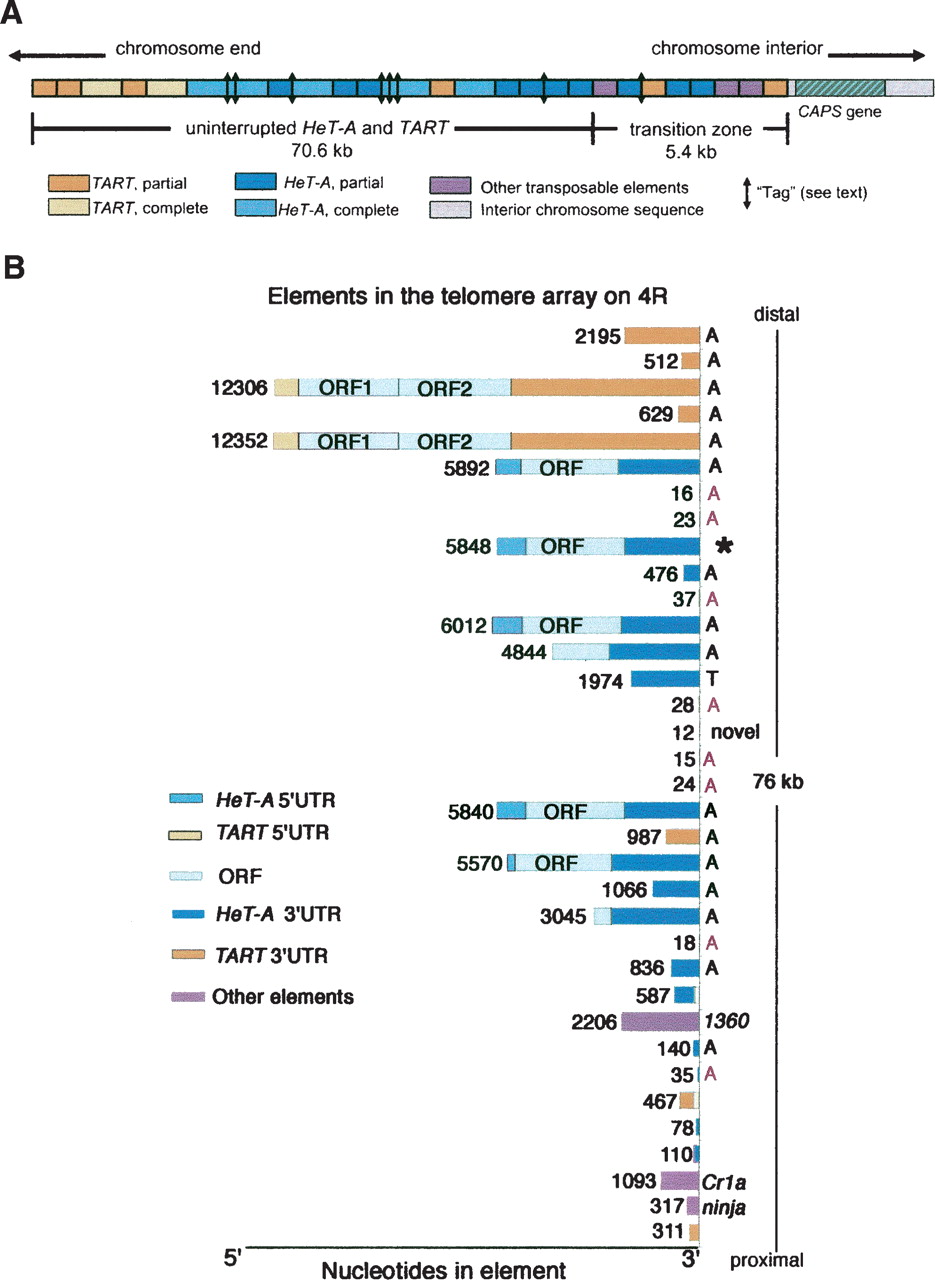
Elements in the HeT-A/TART array in the telomere of 4R. (A) Overview of elements in assembled sequence. Not drawn to scale. End of chromosome is on left. The right end begins with the most distal gene, CAPS, 425 bp from most proximal TART. All HeT-A and TART elements are in the same orientation, and except for those in the transition zone, all truncated elements have lost sequence from the 5 end. (For details on size and sequence content of particular elements, see B.) (B) Elements from the HeT-A/TART array in A. Each bar represents an element in the array drawn to scale with the total number of nucleotides indicated at the 5 end. The most distal element in the assembled array is on top, and the most proximal telomeric element is at the bottom. Because elements are variously truncated from the 5 end, they are aligned from the 3 end (at the right axis). In the array the 3 -most sequence of each element is actually connected to the 5 end of the element beneath it, but elements are shown separately for clarity. Open coding regions are light blue; complete coding regions are marked ORF. 3 ends marked A have an intact 3 end and oligo(A). HeT-A oligo(A) tails in this study range from 3 to 26 bp, averaging 8 bp; TART tails are longer, from 14 to 23 bp with an average of 18. Red “A” indicates elements thought to be “tags” (see text). Nontelomeric elements in the array (purple) are indicated by name on the right axis. Element marked “T” has an intact 3 end but has oligo(T) rather than oligo(A). Asterisk (*) indicates an element missing final GTT and oligo(A). Elements not marked “A” are 3 -truncated and shown displaced from the right axis to show their alignment with complete elements; in some cases there are enough missing 3 nucleotides to be seen as white space between the element and the right axis of the graph.



