


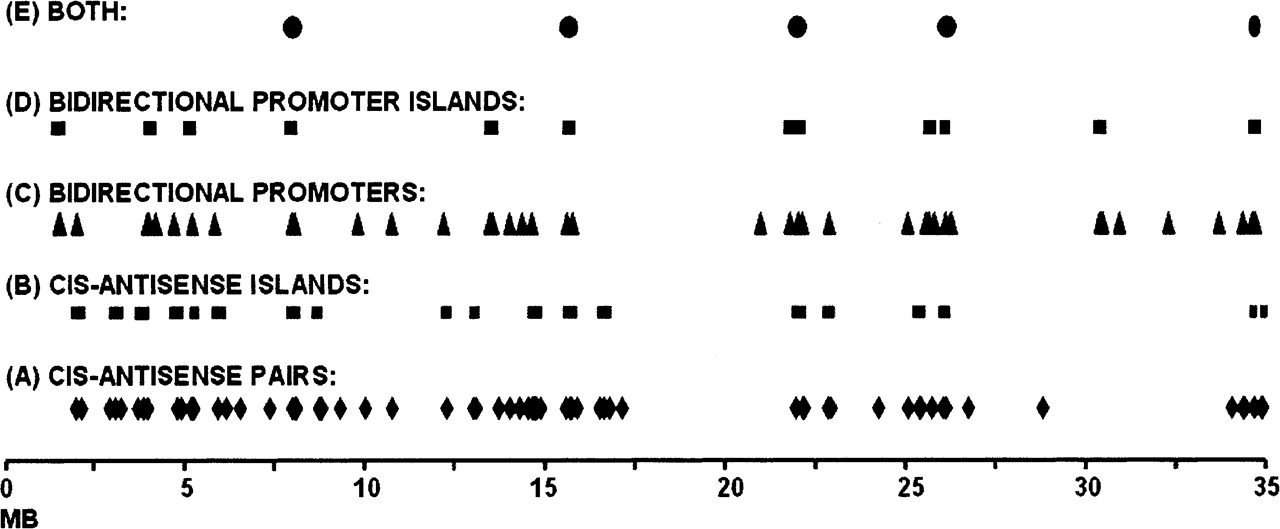
Clustering of UGPs along 35 Mb of chr22q. UGPs cluster near one another more frequently than expected by chance on the 35 Mb of human chr22q. Cis-antisense gene pairs (A) are defined as forming an island (B) if two pairs lie within 250 kb of one another. Similarly, pairs of genes that may share a putative bidirectional promoter (C) are defined as forming an island (D) if they lie within 250 kb of one another. Sixty-three of 77 (82%) cis-antisense gene pairs and 26 of 42 (62%) of gene pairs sharing a putative bidirectional promoter lie in islands. Ten thousand simulations of distributions of these features into 35 Mb of genomic space did not yield any distribution with clustering as great as that observed (see text for details). Five regions of 22q harbor both cis-antisense islands and putative-bidirectional promoter islands (E).



