


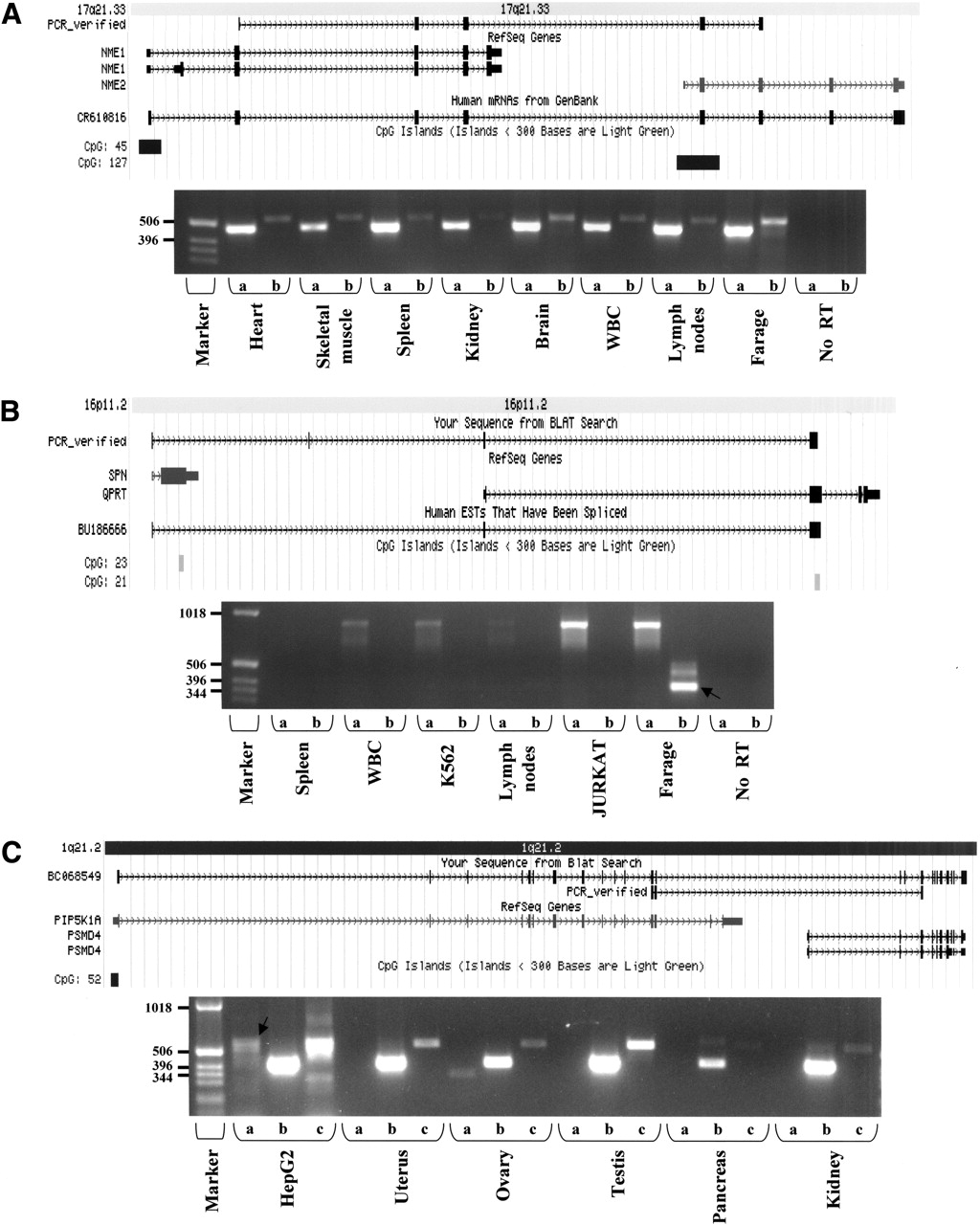
Selected examples of experimentally verified transcription induced chimeras. Shown are snapshots taken from the UCSC genome browser (http://genome.ucsc.edu/), presenting the alignment of expressed sequences to the genome, as well as the location of CpG islands (Gardiner-Garden and Frommer 1987). A total of 70% of the downstream genes involved in TICs possess CpG islands in their 5′ regions, indicating that they are also regulated as single genes. Boxes represent exons, with thinner boxes representing the untranslated regions (UTRs). Arrowed thin lines represent introns. “PCR_verified” represents the chimeric sequence validated by RT–PCR. Beneath are RT–PCR results showing the fusion events (see Methods). (A) Fusion transcript between NME1 and NME2 creating a predicted fused protein. This transcript is supported by 30 ESTs (one is shown in the figure), and was found to be ubiquitously expressed in human tissues. The same fusion event was also detected in mouse ESTs. In the gel image—lanes a indicate the NME1 wild-type (WT) transcript and lanes b indicate the fused (TIC) NME1-NME2 transcript. (B) Fusion transcript between sialophorin (SPN) and quinolinate phosphoribosyltransferase (QPRT) demonstrates the donation of SPN regulatory sequence (5′UTR) to the QPRT transcript. The fusion was experimentally detected in RNAs from the Farage cell line (B-lymphoma). In the gel image—lanes a indicate the wild-type SPN and lanes b indicate the fused (TIC) SPN-QPRT transcript (validated product marked by black arrow). (C) Fusion transcript between phosphatidylinositol-4-phosphate 5-kinase (PIP5K1A) and proteasome 26S subunit non-ATPase 4 (PSMD4) on chromosome 1q21. The fusion event was discovered by identification of retroposed, chimeric processed expressed pseudogene residing on chromosome 10q23. No EST supports this fusion, but it was verified by RT–PCR. The RNA BC068549, expressed from the processed pseudogene on chromosome 10, is shown aligning to both genes. In the gel image—lanes a indicate the fused (TIC) PIP5K1A-PSMD4 transcript on chromosome 1 (validated product marked by black arrow); lanes b indicate the PIP5K1A (WT), and lanes c indicate the active transcription of the retroposed gene from chromosome 10, which was found to be ubiquitously expressed. Primers were designed from regions that are diverged between the fusion transcript and the retrogene, so that each product will be uniquely amplified (Supplemental Table S2). Products were verified by direct sequencing.



