


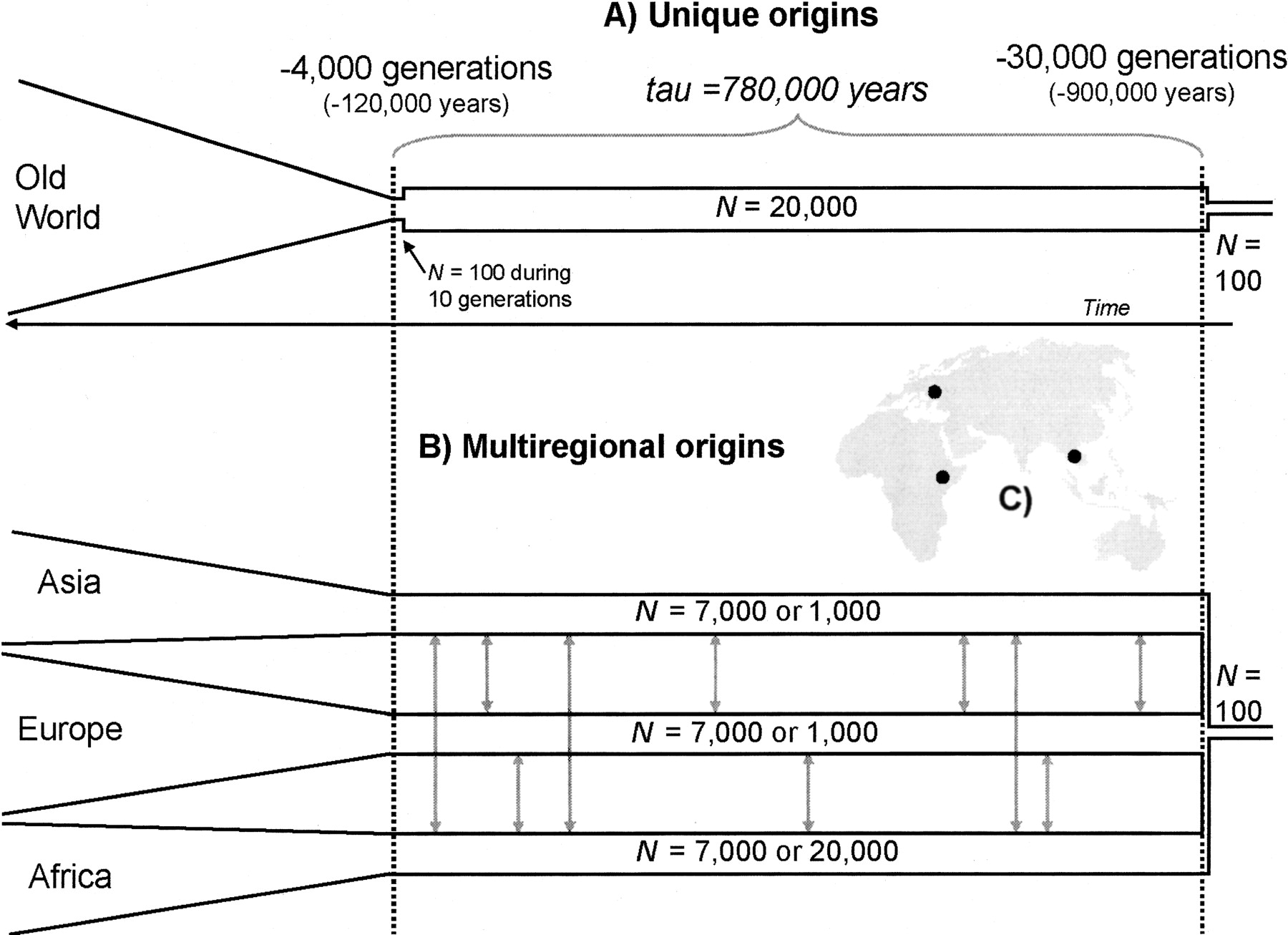
Demography and timeline of the different simulated evolutionary models. (A) Unique origin (UO) model. In this model, 30,000 generations ago, a small population (N = 100 genes) went through a demographic expansion after a first speciation event. Then, 4000 generations ago, a range expansion followed a bottleneck of 10 generations to mimic a second speciation event. The large population preceding the speciation and range expansion can be considered to be a large subdivided population. (B) Multiregional evolution (ME) model. As in A, a small population went through a speciation event and instantaneously colonized the three continents 30,000 generations ago. For 26,000 generations the continents harbored relatively large populations and exchanged occasional migrants (see Table 1 for continent population sizes and migration rates under different scenarios). Then, 4000 generations ago, three range expansions were initiated from the three different origins shown in C.



