


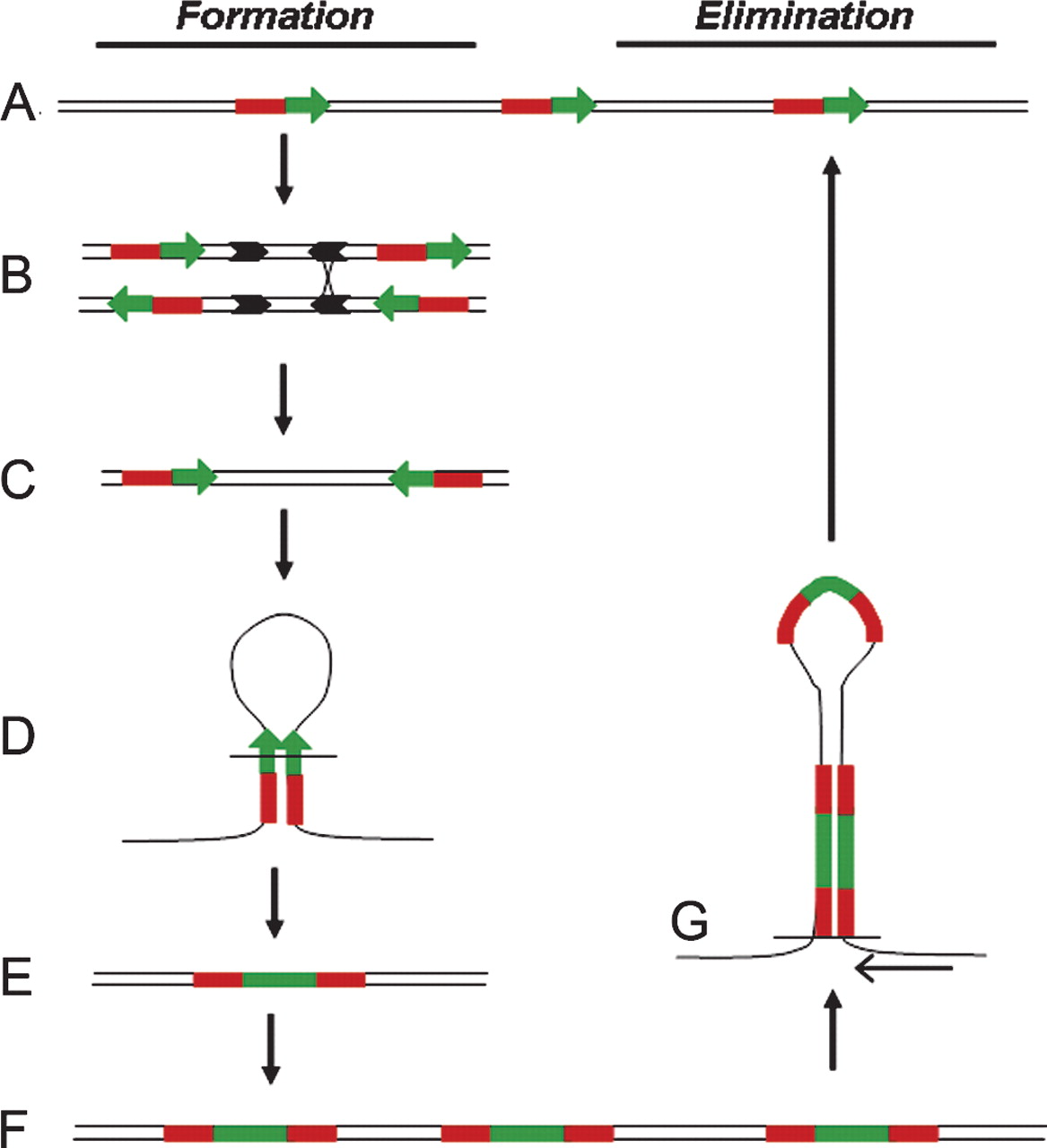
Competing processes underlying palindrome formation, variation, expansion, and elimination. The pathway of formation on the left and the pathway of elimination on the right. (A) Schematic representation of canonical rDNA genes (5′ in red, 3′ in green) separated by IGS sequences. (B) One of many possible mechanisms, inversions are presented based on recombination between Alu repeats (represented by black arrows) of opposite orientation present in the IGS sequences. (C) One of the two products of recombination with crossover in B producing inverted rDNA genes. (D) Single-strand loop formation (possibly with cleavage at the base). (E) A 3′–3′ palindrome generated by the preceding reactions. (F) Expansion of the palindromic sequence. (G) Competing reaction of elimination of the palindromic sequence, analogous to those presented in D or DNA replication slippage, shown by the arrow coming from the right.



