


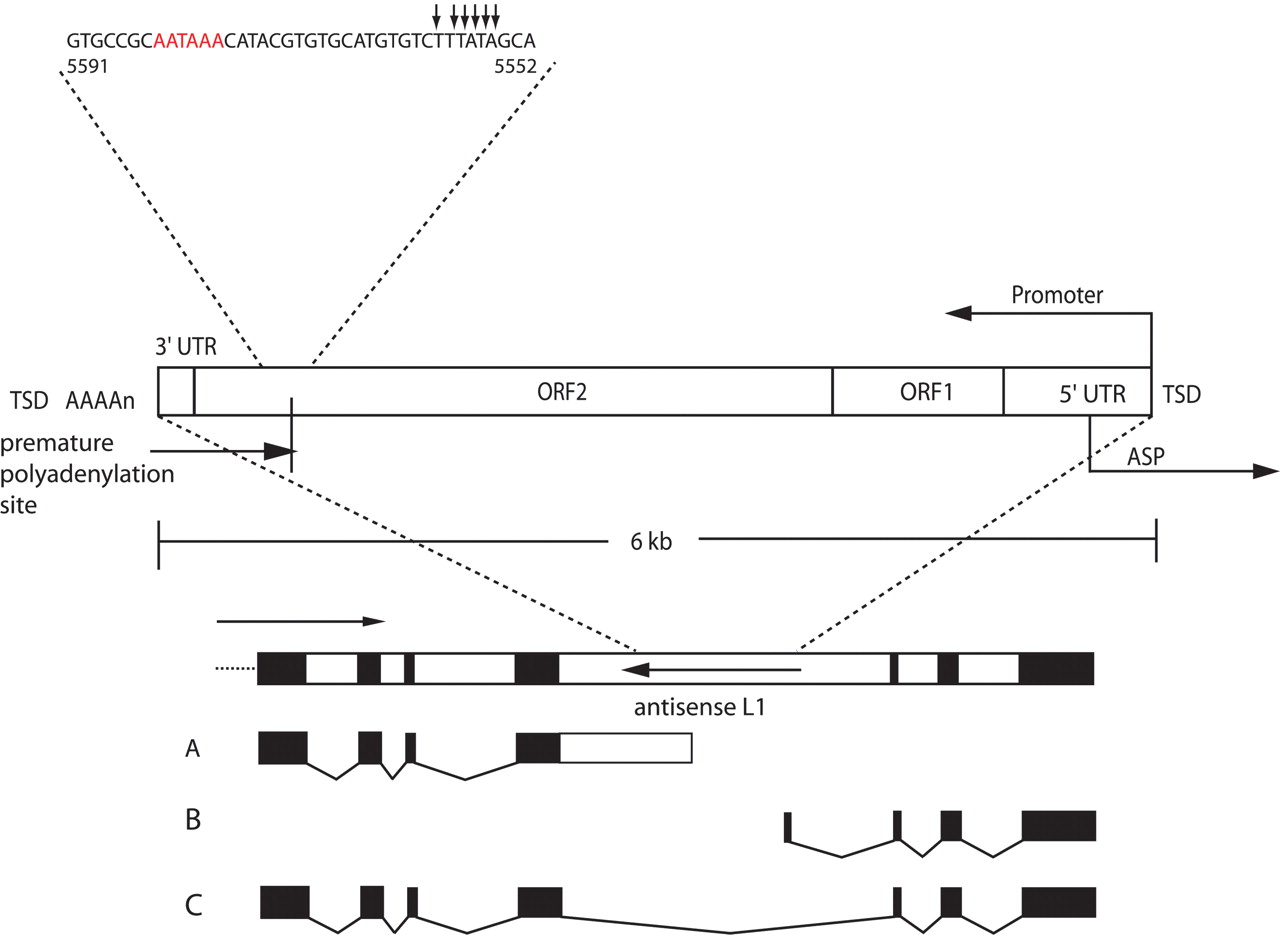
Gene-breaking model. A generic gene is shown, containing an L1 element positioned in the antisense direction in an intron. Three transcripts could result from this arrangement: transcript A, an early-terminating upstream transcript containing the 5′ exons, part of the intron, and part of L1; transcript B, a transcript originating from the antisense promoter in L1 and containing part of L1 spliced to the downstream exons; and transcript C, the native (expected) transcript. Arrows show the direction of transcription; the arrow for the antisense L1 indicates transcription from the native L1 promoter. Red letters, the poly(A) signal; small arrows, polyadenylation sites; TSD, target site duplication; UTR, untranslated region; ORF, open reading frame; ASP, antisense promoter.



