


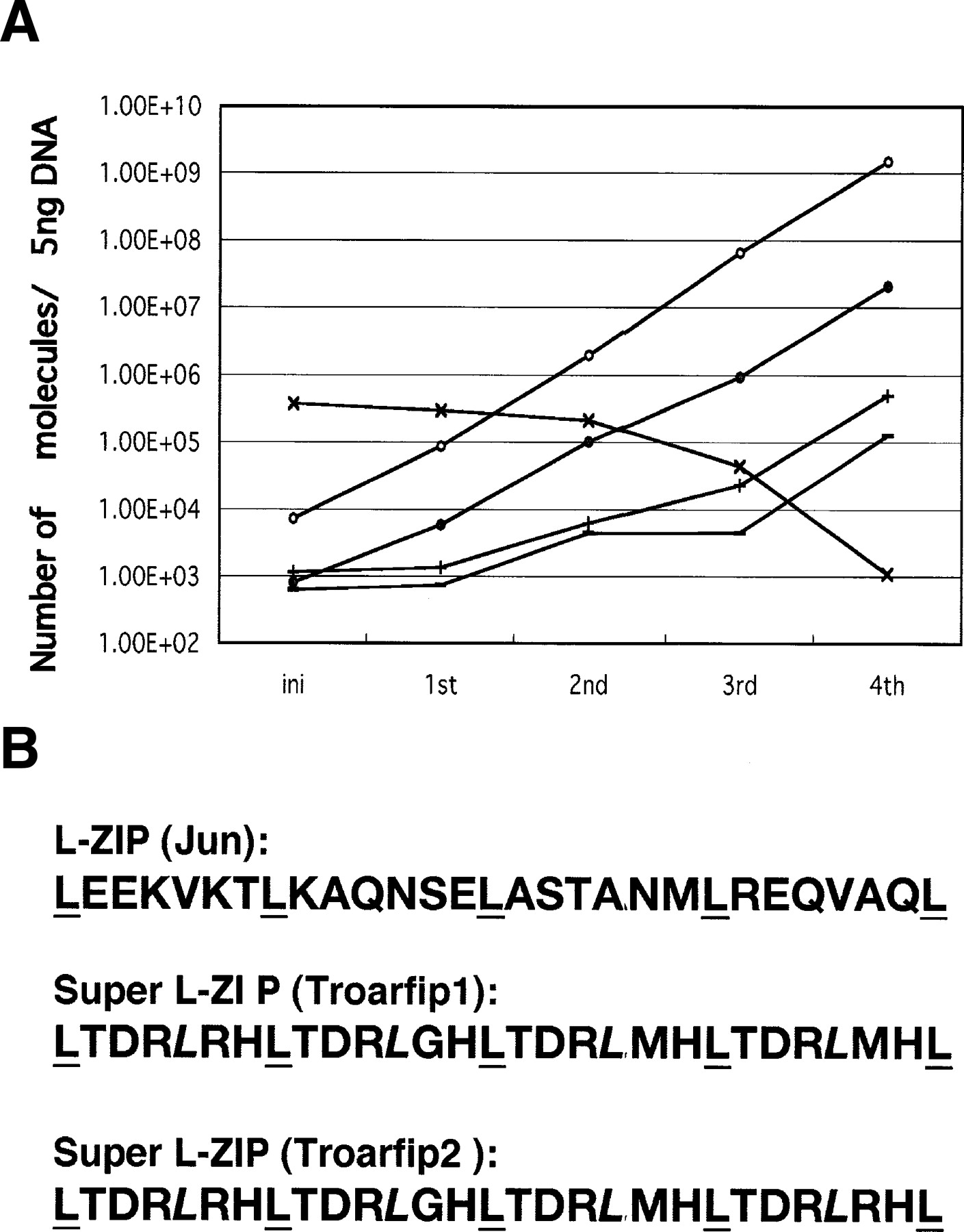
Detection of a well-known protein complex and novel L-ZIP motifs. (A) Evidence of a protein complex enrichment. The real-time PCR of Junb (+) and Elf1 (–) in each round's pool (from 1st to 4th) of Experiment 2 in Table 1. (Ini) Initial library. Jun (○) and Jund1 (•) are positive controls and β-actin (×) is a negative control. Jun, Jund1, and Junb are members of the Jun family that interact directly with Fos. Elf1 is a wellknown protein, coprecipitated with Fos/Jun family complexes and interacting indirectly with Fos mediated by Jun family members (Chinenov and Kerppola 2001). (B) Novel L-ZIP motifs in hypothetical frame-shifted proteins. L-ZIP of Jun has a single L-ZIP, which is composed of the underlined leucines every seven amino acids. The super L-ZIP of Troarfip1 or Troarfip2 has a dual-L-ZIP, which is composed of the underlined leucines and the italic leucines every seven amino acids, alternately. Both super L-ZIP motifs are almost the same except for one amino acid.



