


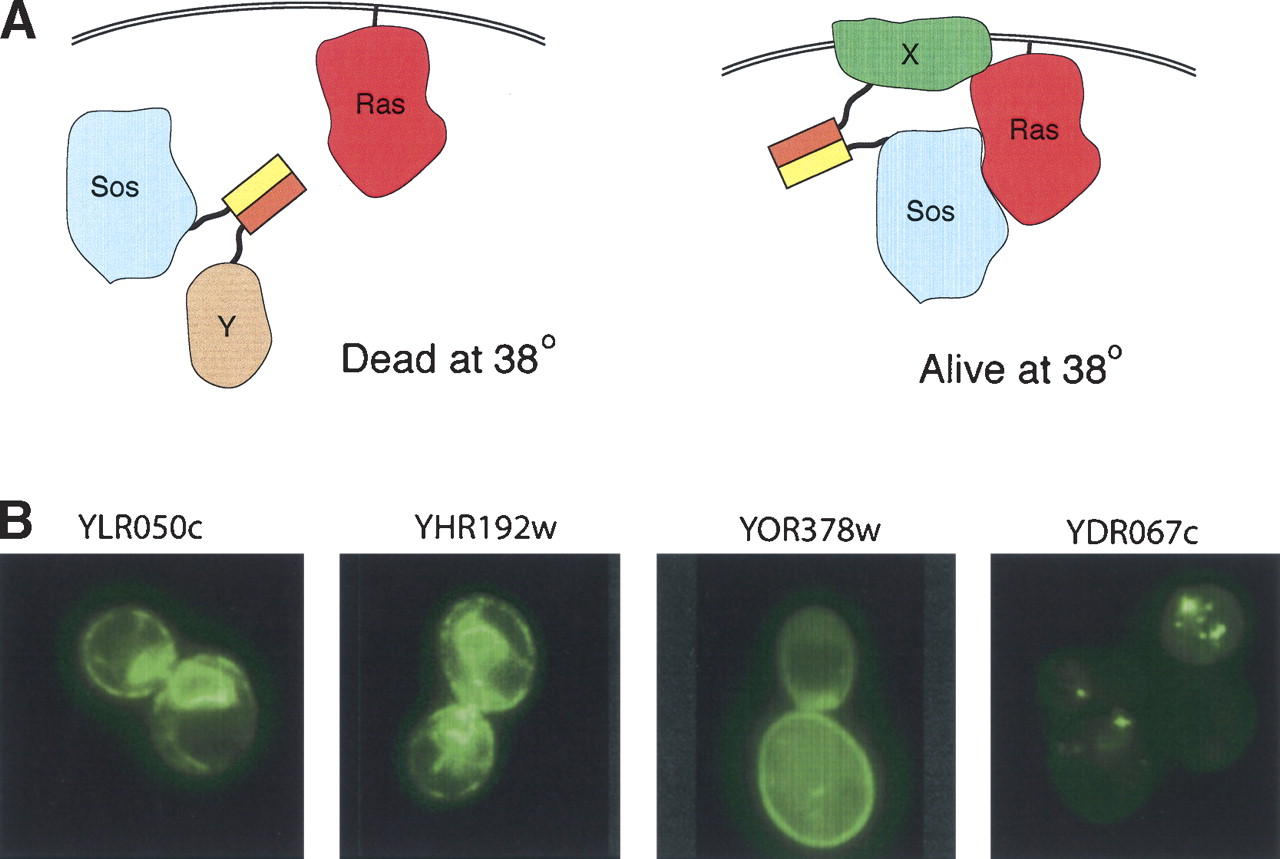
A genetic screen that uses a Fos and Jun–mediated coassociation to identify membrane-localized proteins. (A) The screen is derived from the Sos-Ras recruitment system, which uses a yeast strain in which the Ras GTP exchange factor Sos, the human homolog of yeast Cdc25, replaces a temperature-sensitive Cdc25. Sos will function, and thus permit growth at the restrictive temperature, only if it is localized to the plasma membrane where it can interact with Ras. A plasma membrane-associated protein (protein X) is identified in the Fos-ORF library by its ability to bring the Sos-Jun fusion, via a leucine zipper interaction, into close proximity with Ras. (B) Localization of four proteins annotated in YPD as having an unknown localization (molecular component unknown). The Fos fusions isolated in the screen were coexpressed in yeast with a Jun-GFP fusion and the GFP imaged by fluorescence microscopy. The first three panels show proteins with likely plasma membrane and endoplasmic reticulum localization and the last panel shows a protein possibly localized in a transport vesicle.



