


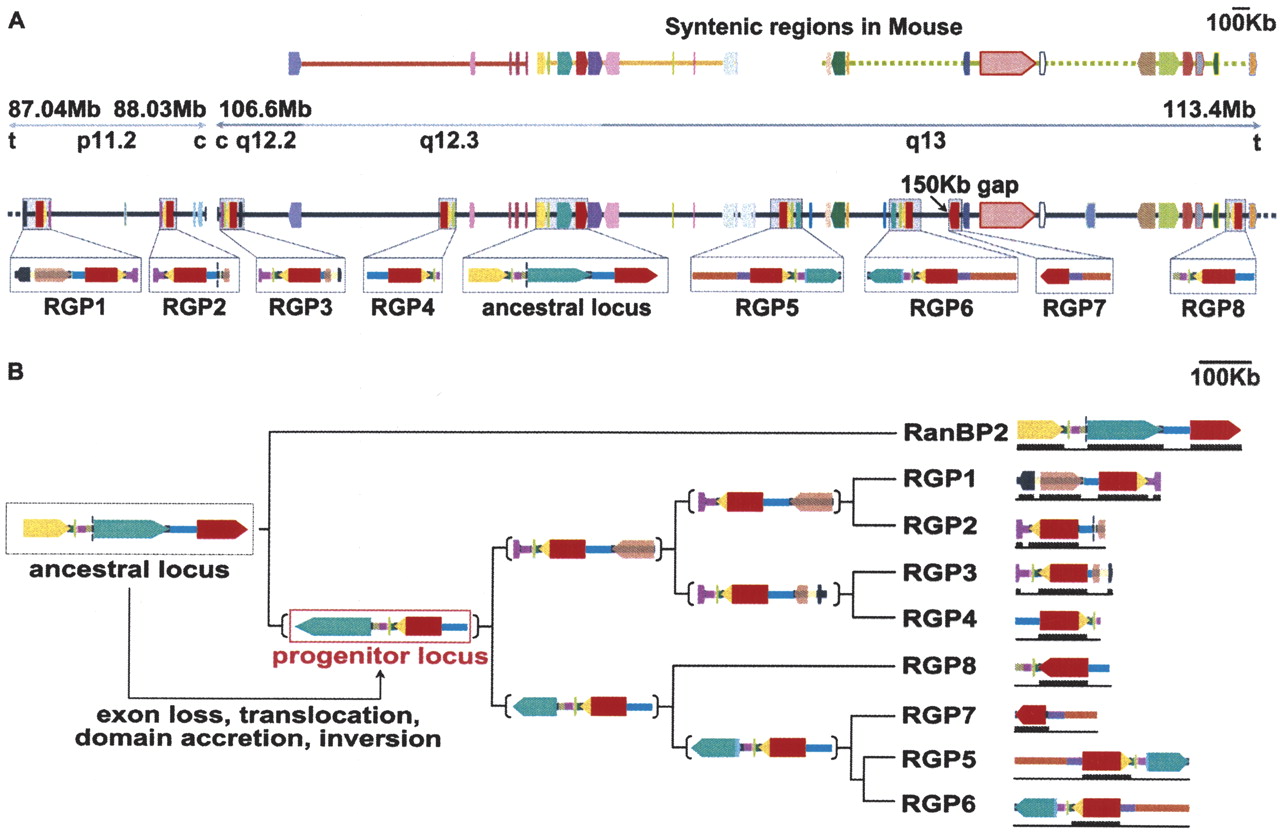
Evolutionary mechanism for the origin of the new gene family. The genes are shown as arrows with different colors associated with different genes. (Red) RanBP2; (yellow) GCC2; the RGP paralogs are shown in red for the RanBP2-derived region and in yellow for the GCC2-derived domain. The color scheme of the other genes as well as a larger version of the figure are given in Supplemental Figures S4 and S5, respectively. (A) Gene composition of the regions on human Chromosome 2 where the duplicated fragments containing the RGP paralogs are interspersed. The duplicated segments are highlighted in gray and enlarged in the lower boxes, in which similar intergenic sequences are also reported (see Methods for more details). The vertical dashed bars in both the segments containing RGP2 and RanBP2 indicate intergenic regions with no detectable intrachromosomal matches. The 3′-end of the RGP7 copy could not be assessed, as the human genome build 34 has a 150-kb gap in that region. The chromosomal bands, the region borders, and the direction to the centromere (c) and telomeres (t) are shown in the upper bar. The syntenic regions in mouse Chromosomes 10 (yellow), 17 (orange), and 2 (green) are also shown. (B) Family tree of the RGP and the RanBP2 paralogs, and putative mechanism for the formation of the RGP progenitor locus. At each branching point, the genomic structure of the putative progenitor is depicted. The ancestral locus, which contains RanBP2 and GCC2 and is syntenic in mouse, underwent several genetic rearrangements leading to the formation of the progenitor locus. The rearrangements included an inversion of the entire region, a loss of the 3′-exons from RanBP2, a partial deletion of the RanBP2 exon 20, and a translocation that places the 3′ noncoding region just downstream of the last four exons of the GCC2 duplicated gene. This event leads to the accretion of the GRIP domain. We assume that the progenitor locus already contained the newly formed RGP gene, as all the RGP duplicates contain the GRIP domain and a shorter version of RanBP2-derived exon 20. The bars reported under each of the duplicated segments indicate the presence of unambiguous expression data (ESTs and cDNAs) for the corresponding gene.



