


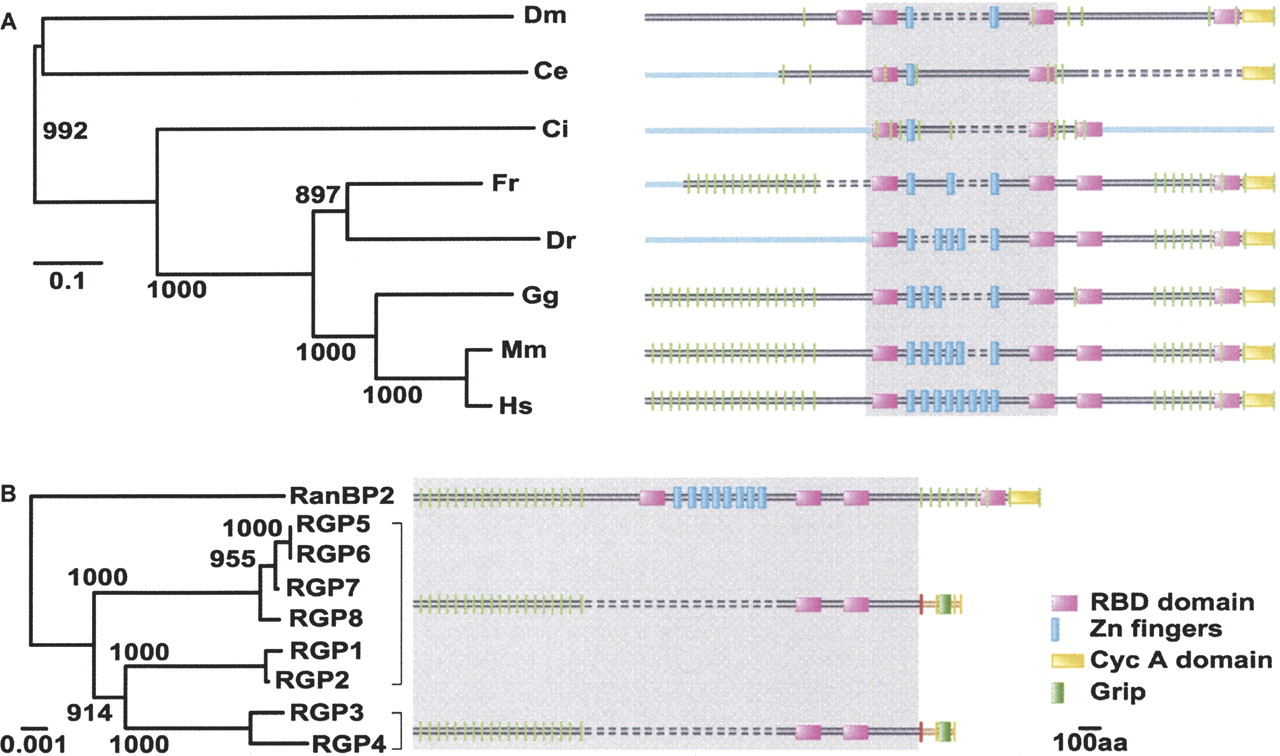
Conservation of the RanBP2 gene during metazoan evolution and its expansion in human. For each protein, the corresponding domain architecture is reported. The proteins are depicted reproducing the sequence alignments, the dashed bars representing the gaps in the alignments. The regions used to build the trees are highlighted in gray. (A) Phylogenetic tree of the RanBP2 orthologs in representatives of fully sequenced metazoan genomes. The light-blue bars represent protein regions that were not predictable because of gaps in the corresponding genomes. The exon-intron boundaries of the encoding genes are reported as vertical green bars. (Ce) Caenorhabditis elegans; (Ci) Ciona intestinalis; (Dm) Drosophila melanogaster; (Dr) Danio rerio; (Fr) Fugu rubripes; (Gg) Gallus gallus; (Hs) Homo sapiens; (Mm) Mus musculus.(B) Family tree of RanBP2 and RGP genes. The exon-intron boundaries of RanBP2-derived region (exons 1-20) are shown in green, those of GCC2-derived part (exons p-r) are in yellow. The RGP-specific intron, bearing the fusion between the RanBP2- and GCC2-derived regions, is depicted in red. The RGP regions encoded by the RanBP2-derived DNA are shown in black, the ones encoded by the GCC2-derived DNA in brown.



