


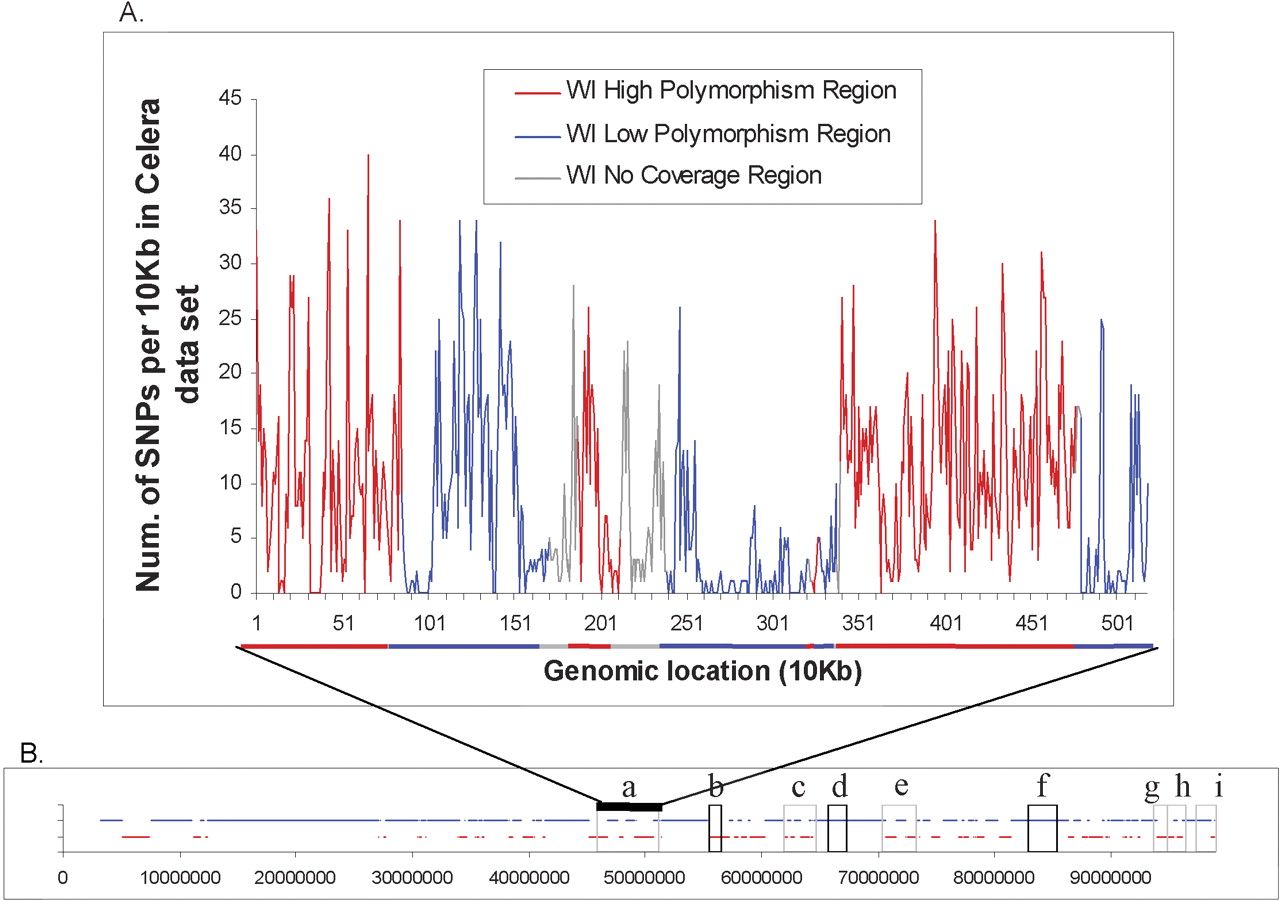
(A) SNP density (number of SNPs per 10 kb) in the largest melded block (5.2 Mb) discovered in our analysis. The haplotype of C57BL/6J is different from the one shared by the four other strains, 129S1/SvImJ, 129X1/SvJ, A/J, and DBA/2J. This haplotype block was split into eight WI blocks, and the red and blue colors label the corresponding WI blocks in which C57BL/6J and 129S1/SvImJ were projected to have different or the same alleles in the WI study. (Gray area) Regions with no data in the WI map. (B) Locations of the nine largest melded haplotype blocks defined by our analysis in which C57BL/6J and 129S1/SvImJ have different haplotypes. The WI haplotype map was extracted from the file (http://www.broad.mit.edu/personal/claire/strainsnplist_all.xls), and the melded haplotype blocks in our study were enclosed in rectangles; those that are labeled with a gray line (i.e., a, c, e, g, h, and i) represent a split of melded haplotype blocks into multiple WI blocks.



