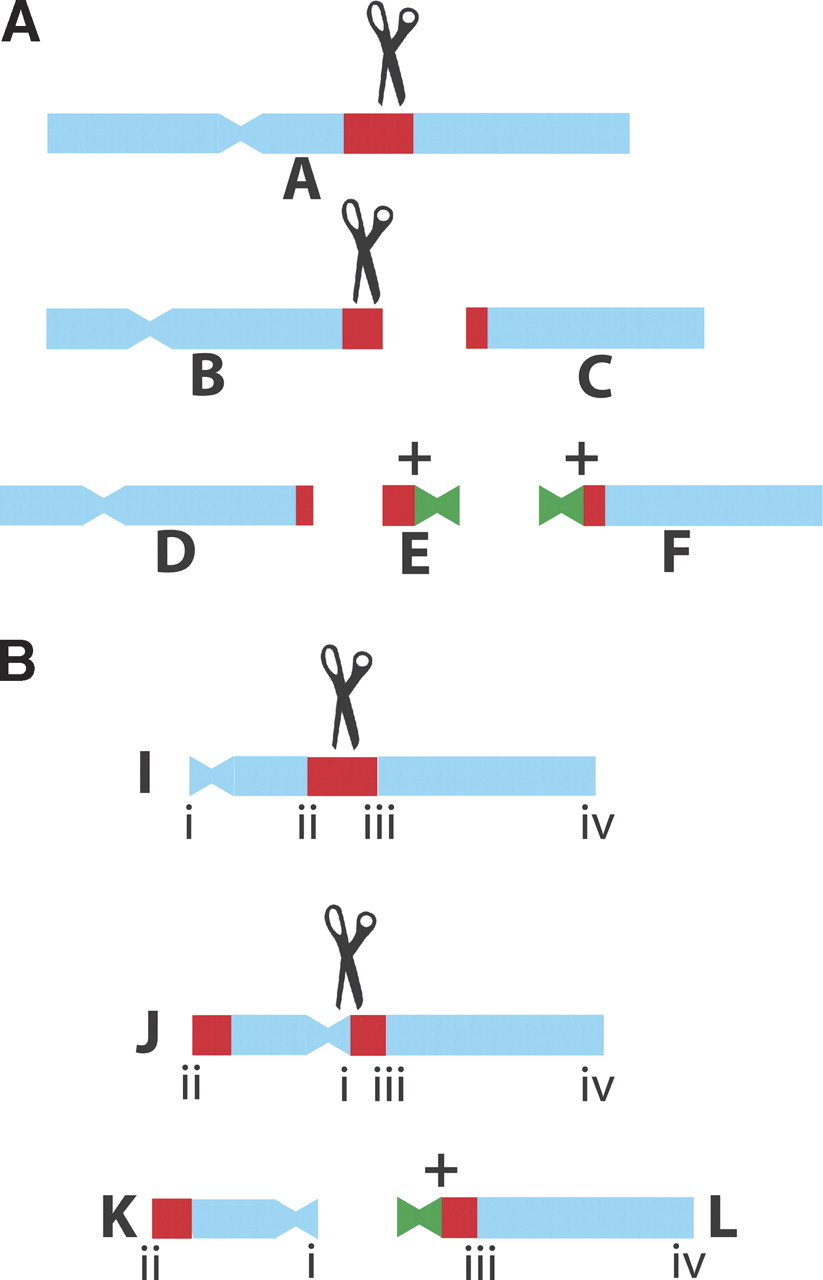
The “fragile breakage” model for the evolution of the canine karyotype. Schematic models of chromosome breakage within hotspots for metacentric (A) and acrocentric (B) chromosomes, showing how initially interstitial hotspots may be redistributed to subtelomeric and pericentromeric locations. (A) A metacentric Chromosome A breaks at the hotspot (shown in red), thereby forming Chromosome B and fragment C that lacks the original centromere. The hotspot fragment now resides within the subtelomeric regions of B and C. Further breakage within the subtelomeric hotspot of B may give rise to Chromosome D and, through neocentromerization, the microchromosome E. Fragment C may acquire a centromere adjacent to its hotspot. The hotspot, once interstitial in Chromosome A, is now distributed across two subtelomeric, and one pericentromeric, regions. (B) Acrocentric Chromosome I fissures at a hotspot (shown in red), enabling a pericentric inversion that relocates the centromere medially, giving rise to the metacentric Chromosome J. The hotspot fragments now reside in the proximal subtelomeric, and in the quartal pericentromeric, regions of J. A subsequent break at the centromere gives rise to acrocentric Chromosomes K and L. The interstitial hotspot is again redistributed to the subtelomeric and pericentromeric regions.