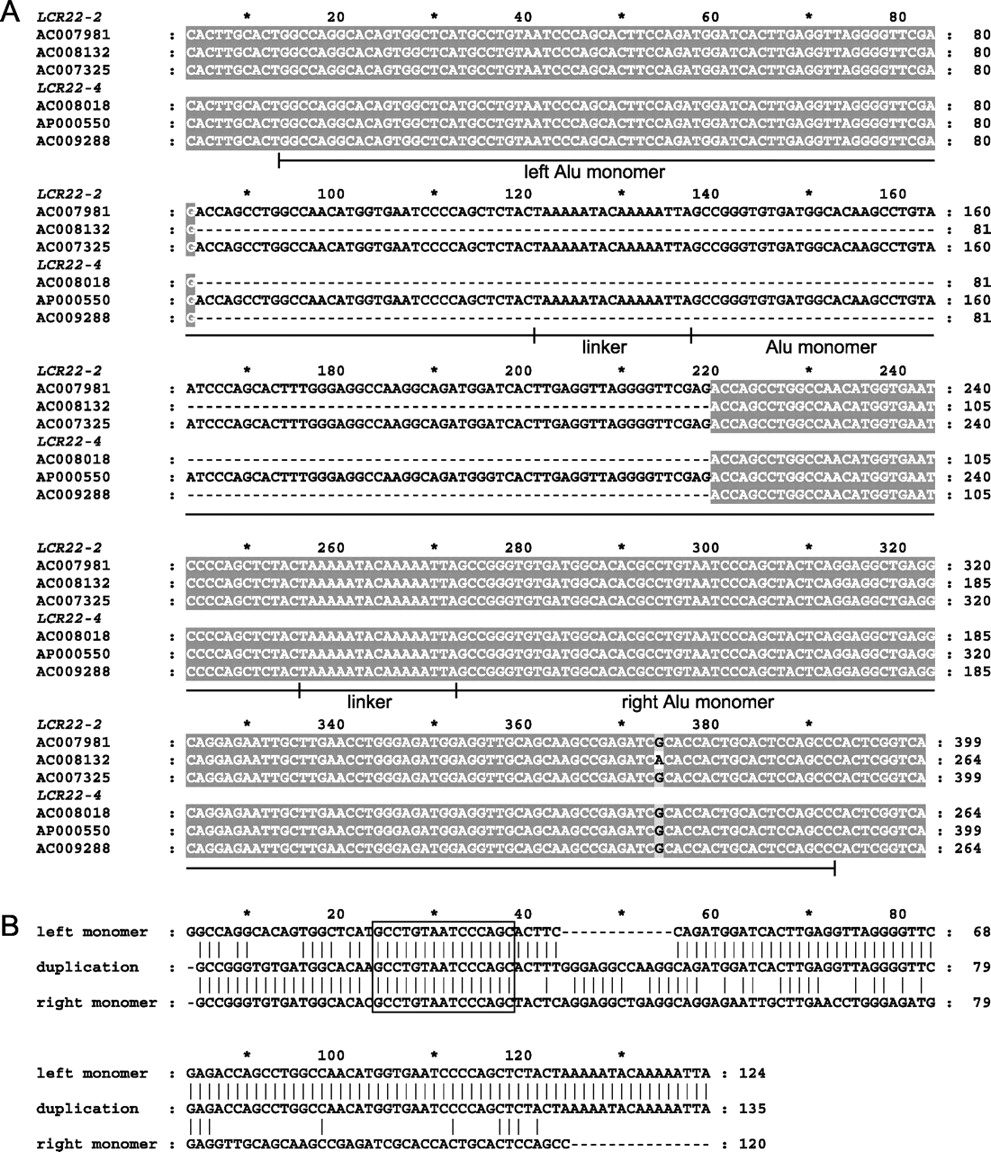
Shared polymorphism of a 153-bp-long indel between LCR22-2 and LCR22-4. (A) Alignment of the indel region from LCR22-2/LCR22-4 clones. These breakpoints correspond to positions 77473–77635 in the clone alignment (Fig. 2). LCR22-2 clone AC008132 and two LCR22-4 clones, AC008018 and AC000928, share the same gap. The rearrangement was caused by homologous recombination between two AluSx monomers and led to duplication of one Alu monomer in the middle. Alternatively, the indel could be a result of deletion in a pre-existing Alu element with a duplicated monomer. (B) Alignment of the duplication breakpoints. We compared the duplicated monomer with the two parental Alu monomers. The first 37 bp in the product is nearly identical to the right monomer. The similarity to the left monomer starts from position 27 and, with the exception of a 12-bp minideletion, continues until the end of the monomer. In a 15-bp region (boxed) the duplicated monomer is identical to both the parental monomers. The original break was probably located within this segment.