


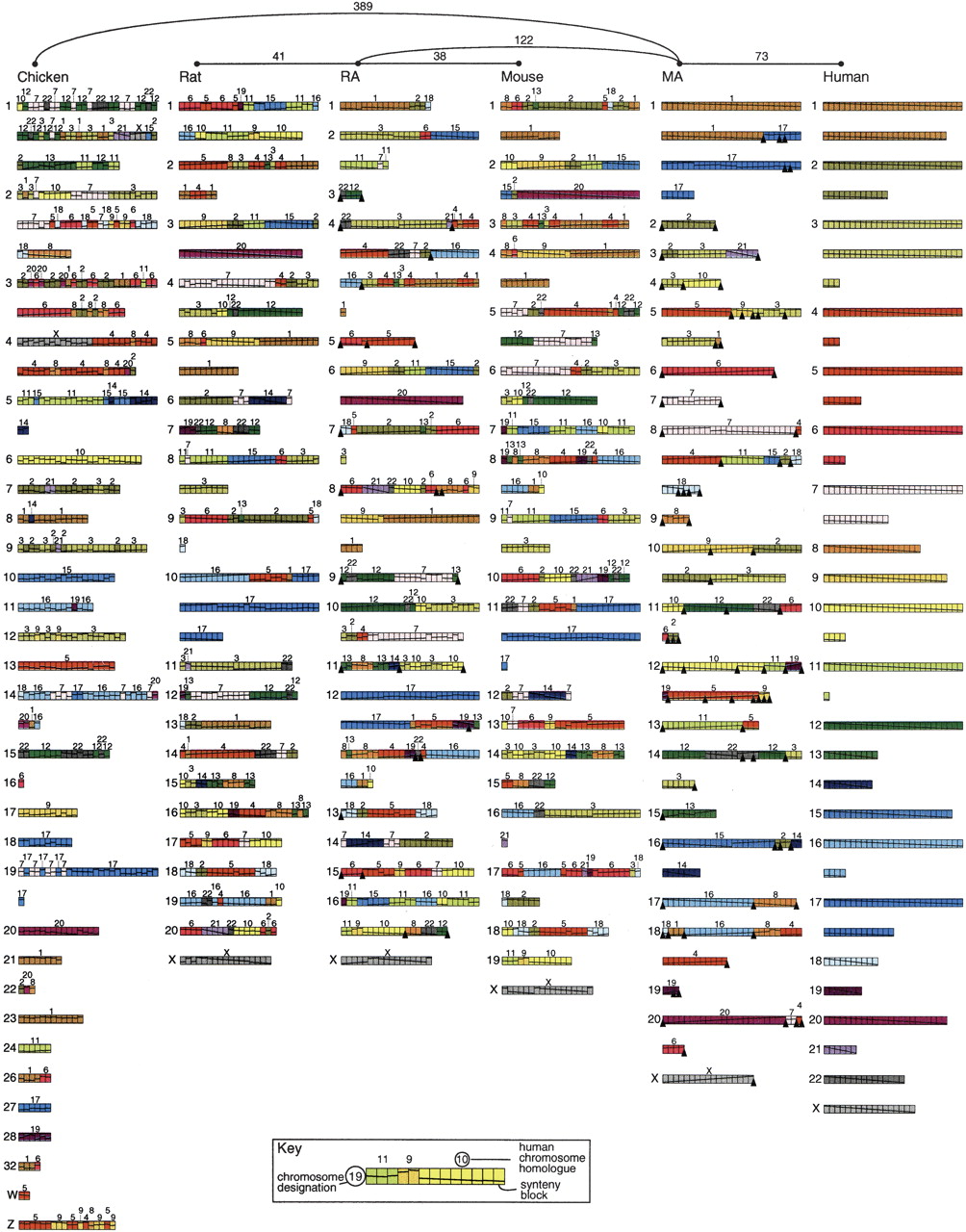
Ancestral murid rodent ancestor (RA), ancestral mammalian ancestor (MA), and evolutionary tree recovered by MGR using the human, mouse, rat, and chicken genomes. Each genome is represented as an arrangement of 586 synteny blocks computed by GRIMM-Synteny on gene-based data in run gene7. Each synteny block is drawn as one unit, regardless of its length in nucleotides. Chromosomes with too many blocks are split into multiple lines. Each human chromosome is assigned a unique color, and a diagonal line is drawn through the whole chromosome. In other genomes, this diagonal line indicates the relative order and orientation of the rearranged blocks. Black triangles below ancestral chromosomes indicate weak adjacencies. The unrooted phylogram at the top of the figure shows the topology of the evolutionary tree; the last common ancestor of human, mouse, rat, and chicken would be somewhere on the edge between Chicken and MA. The minimum number of rearrangements required to convert between two genomes is shown on each edge of that tree.



