


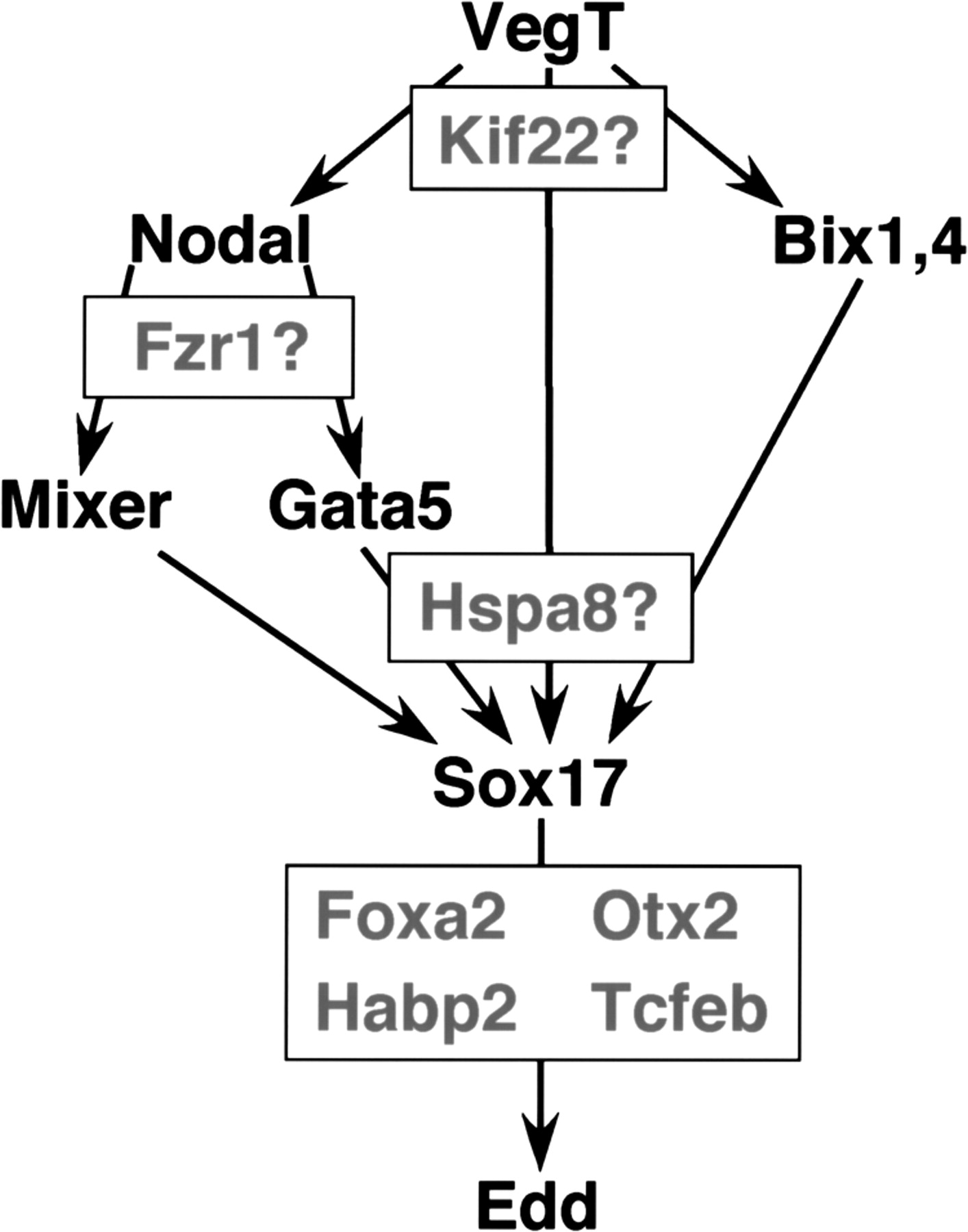
The endoderm specification pathway containing possible locations of identified clones. In Xenopus, the transcription factor, VegT, becomes vegetally localized during oogenesis and regulates downstream signals, including Nodal, to specify the endodermal lineage (Zhang et al. 1998; Xanthos et al. 2001). Cascades of transcription factors, forming downstream targets of Nodal, then regulate the commitment to endoderm. The Mixer-like homeodomain proteins, including Milk/Bix2, Mix.1, Bix1/Mix.4, and Bix4, and the GATA-factors, most notably Gata4 and Gata5, all activate the expression of the downstream target Xsox17β (Hudson et al. 1997; Ecochard et al. 1998; Henry and Melton 1998; Tada et al. 1998; Casey et al. 1999; Reiter et al. 1999; Weber et al. 2000; Dickmeis et al. 2001). Molecules identified in this screen have been placed in possible pathway locations. A recent report has suggested that a kinesin motor protein localizes VegT and Vg1 to the vegetal hemisphere during oogenesis; therefore, we place Kif22 near VegT (Yoon and Mowry 2004). Fzr1 acts directly downstream of Nodal (Stroschein et al. 2001; Wan et al. 2001). Foxa2, Otx2, Habp2, and Tcfeb can induce edd, but not Xsox17β, indicating that they function between these two molecules in the endoderm-specification pathway. For reviews of endoderm specification, see Stainier (2002) and Shivdasani (2002).



