


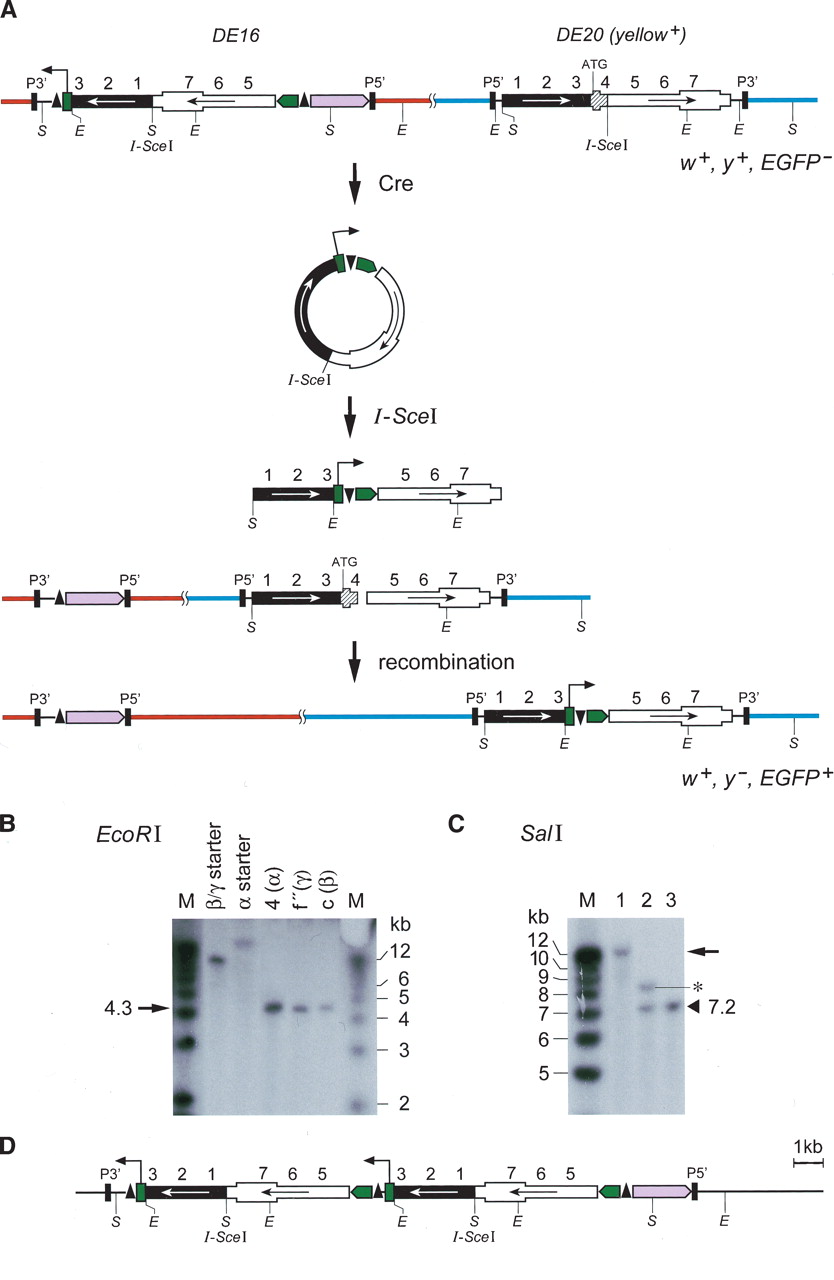
Gene targeting to an I-SceI–induced DSB. (A) Schematic view of the ends-out targeting strategy. Cre recombinase excises an episome from DE16, which is subsequently cleaved by I-SceI to create a linear molecule able to undergo HR with the second transgene DE20, which is also cleaved by I-SceI. Cre-mediated recombination joins the 3xP3 promoter to the EGFP coding sequence. E indicates EcoRI; S, SalI. w+ y– EGFP– and w+ y– EGFP+ indicate the phenotypes of the flies carrying the corresponding chromosomes. (B, C) Verification of targeting by genomic Southern blotting. The arrows mark bands characteristic for targeting. Letters above the lanes denote arbitrary isolate numbers. The starter lines from which the events are derived are indicated in parentheses above the lanes: α, DE16d-DE20z; β, DE16c-DE20h; and γ, DE16c-DE20y. β and γ share the same DE16 starter P-element insertion DE16c. (B) EcoRI digestion. (C) SalI digestion of a targeted event with a novel band at ∼12 kb (lane 1), of a Cre-mediated duplication with two bands at 7.2 kb and 8.5 kb (lane 2) and of DE16 with a single band at 7.2 kb (lane 3). The asterisk marks the band generated by Cre-mediated duplication. (D) Scheme of a Cre-mediated duplication leading to EGFP expression.



