


Cover image
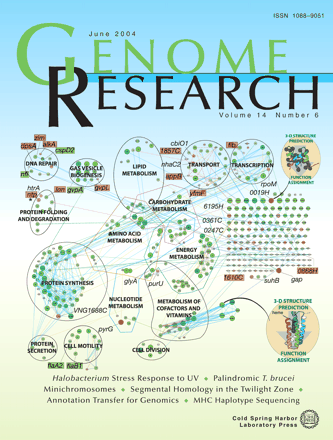
Cover The stress response to UV irradiation in the extremely halophilic archaeon Halobacterium NRC-1. The circular nodes in the network indicate genes whose mRNA levels changed significantly upon UV irradiation. Node size indicates statistical significance of change and the shadings (green for down-regulation and red for up-regulation) indicate the magnitude of change. The edges (lines connecting the nodes) indicate functional associations deciphered through comparative genomics approaches. A dramatic downregulation of core metabolic functions, observed at 60 min under light conditions, is also observed during stress response in bacteria and eukaryotes and is believed to be necessary for maintaining homeostasis and for preventing perpetuation of mutations to succeeding generations. This study also provides functional insights for proteins, with no primary sequence similarity to characterized proteins, through simultaneous analysis of their predicted 3-D structures, expression level changes, and functional associations. The inset figures show predicted 3-D structures for two such proteins: VNG0019H, in the top right corner, was predicted using consensus fold recognition algorithms, and VNG1562H, in the bottom right corner, was predicted ab initio using the Rosetta method. (For details, see Baliga et al., pp. pp.1025–1035.)

