


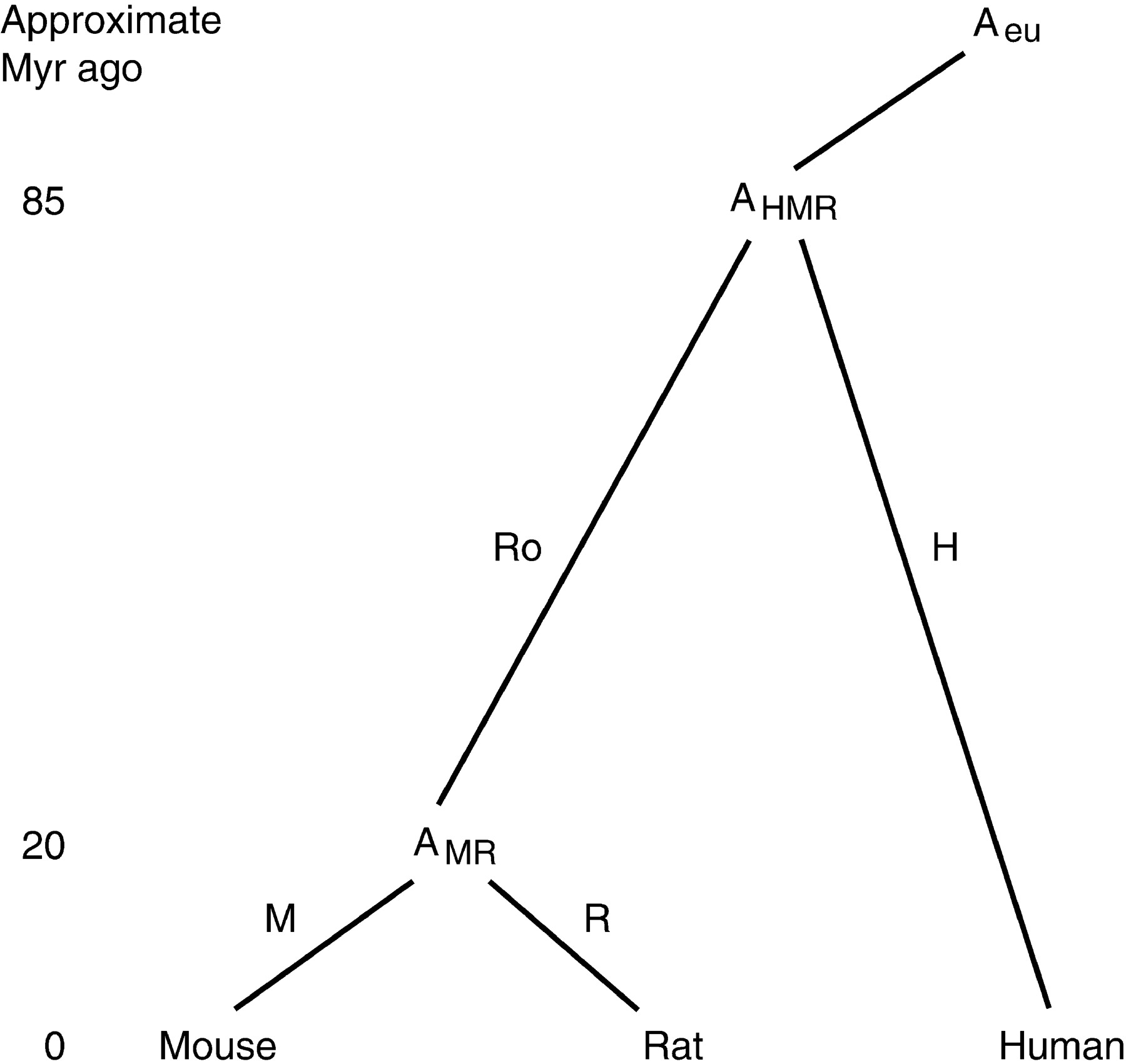
Phylogenetic tree for rat, mouse, and human and their last common ancestors. The last common ancestor for human, mouse, and rat is AHMR, and the last common ancestor for mouse and rat is AMR; AHMR and the ancestors to other eutherian mammalian orders diverged earlier from the last common eutherian ancestor Aeu. The branch from AHMR to human is defined as “human” and is referred to by the suffix “H”, the branch from AHMR to AMR is defined as “rodent” and is referred to by the suffix “Ro”, the branch from AMR to rat is defined as “rat” and is referred to by the suffix “R”, and the branch from AMR to mouse is defined as “mouse” and is referred to by the suffix “M”. Average approximate times for the divergence from AHMR and AMR (Adkins et al. 2001; Mouse Genome Sequencing Consortium 2002; Springer et al. 2003) are given in millions of years.



