


Cover image
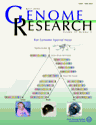
Cover Rearrangement history of the mammalian X chromosome in human, mouse, and rat lineages. The arrangement of the 16 human-mouse-rat large-scale orthologous segments (each containing at least 300,000 nucleotides) located on the X chromosome is shown for the human, mouse, and rat genomes. Possible arrangements of the last common ancestor of mouse and rat ("Mouse-Rat Ancestor") were computed from these. The computations prove that the arrangement shown is the only one that minimizes the number of inversions of these segments on the paths to it from human, mouse, and rat. A possible order of those inversions is illustrated, but the actual order will not be determined until future studies allow us to add more species to this tree. Previous studies found that the arrangement of markers in the human X chromosome was unchanged since before the "Human-Mouse-Rat Ancestor," and our use of outgroup data from dog, cat, and cow is consistent with this (although we cannot rule out the possibility that the second segment from the right in human was inverted on the human lineage). The drawings of creatures at the ancestral nodes are probably similar to the last common ancestors of the species indicated at the nodes. (For details, see Bourque et al., pp.507–516. [Artwork provided by G. Bourque, W. Murphy, M. Krzywinski, P. Pevzner, and G. Tesler. Placental ancestor image used with permission from Nature © 2004, 416: 816-822. Mouse photograph courtesy of Darryl Leja, National Human Genome Research Institute, National Institutes of Health, Bethesda,MD.])

