


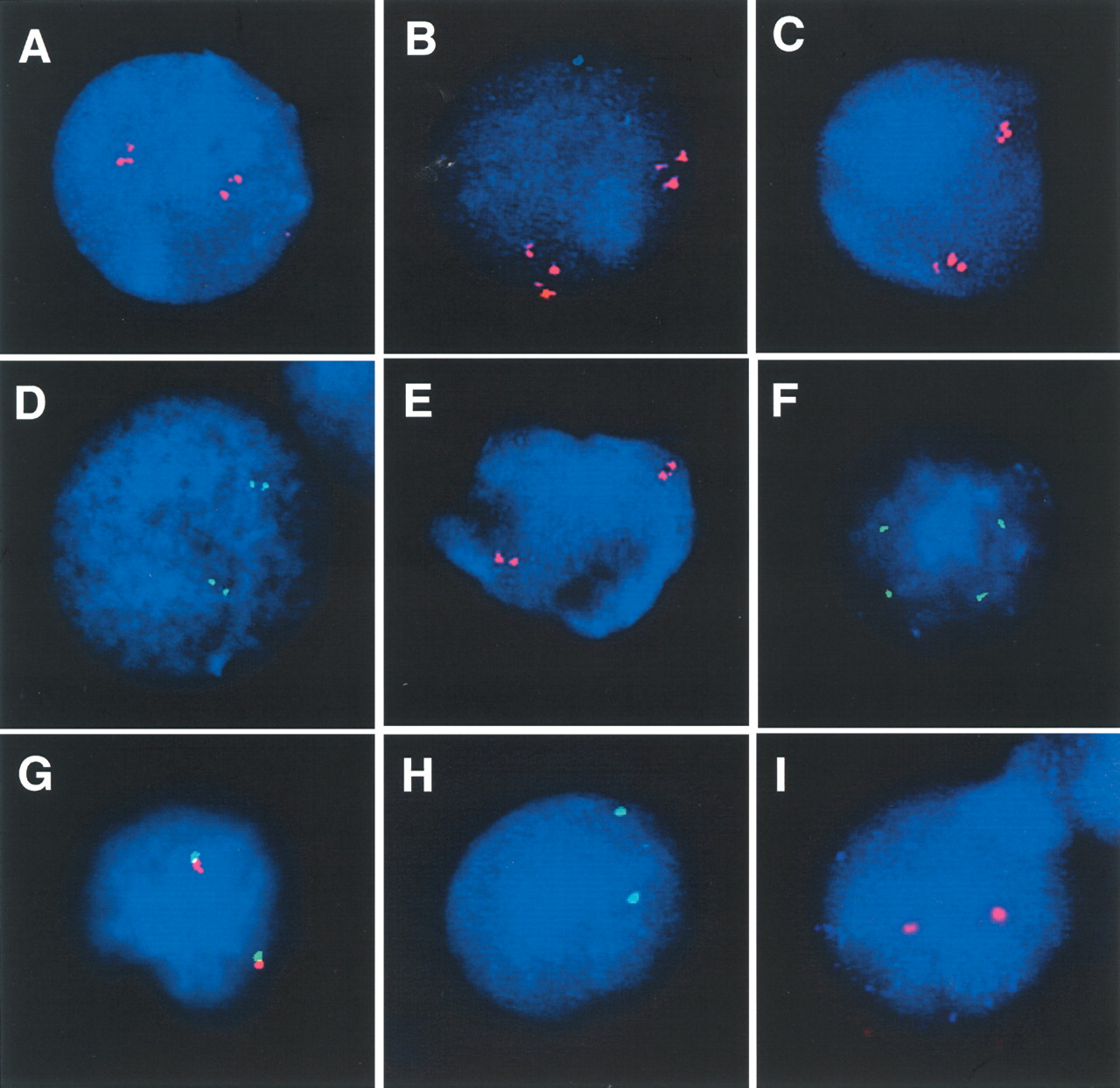
Evolutionary FISH analyses of LCR17ps. Interphase FISH with the LCR17pA/C- and LCR17pA/D-derived BAC clone CTD-3157E16 showed the presence of at least 2 signals on each chromosome for human (A), orangutan (B), and baboon (C). LCR17pA/B-derived clone RP11–640I15 showed four signals (green or red), two from each chromosome, in interphase nuclei of cell lines from human (D), chimpanzee (E), gorilla (F) [the separation of the signals is due to the presence of t(4;19) with LCR17pA/B and LCR17pB being present on separate derivative chromosomes]. Only one signal per chromosome homolog was observed in orangutan (G), baboon (H), and squirrel monkey (I). (G) The cohybridization of BAC clones RP11–640I15 (red) and, adjacent to it on the telomeric side, LCR-free RP11–726O12 (green) demonstrated that the LCR17pA/B was the progenitor copy (see Results).


