


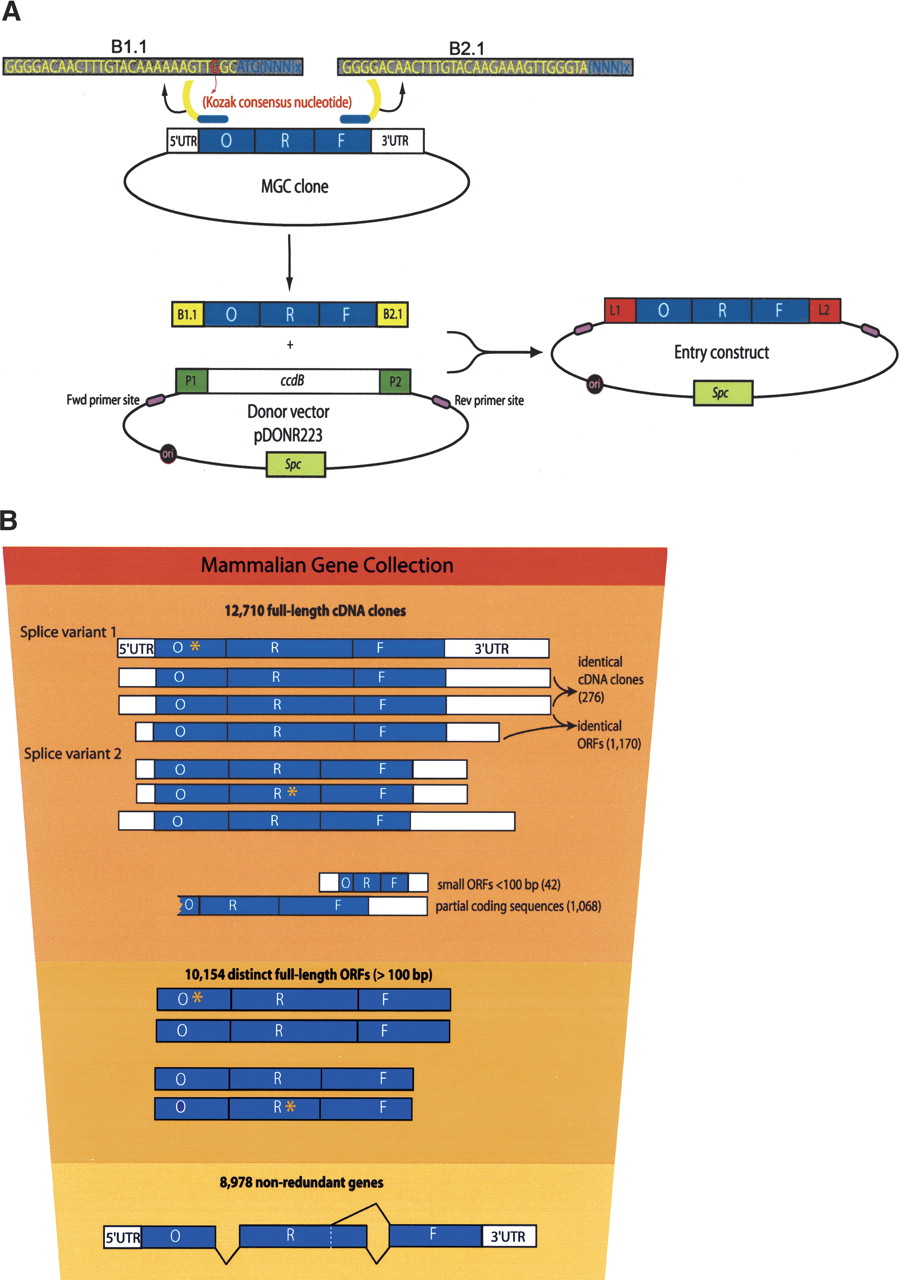
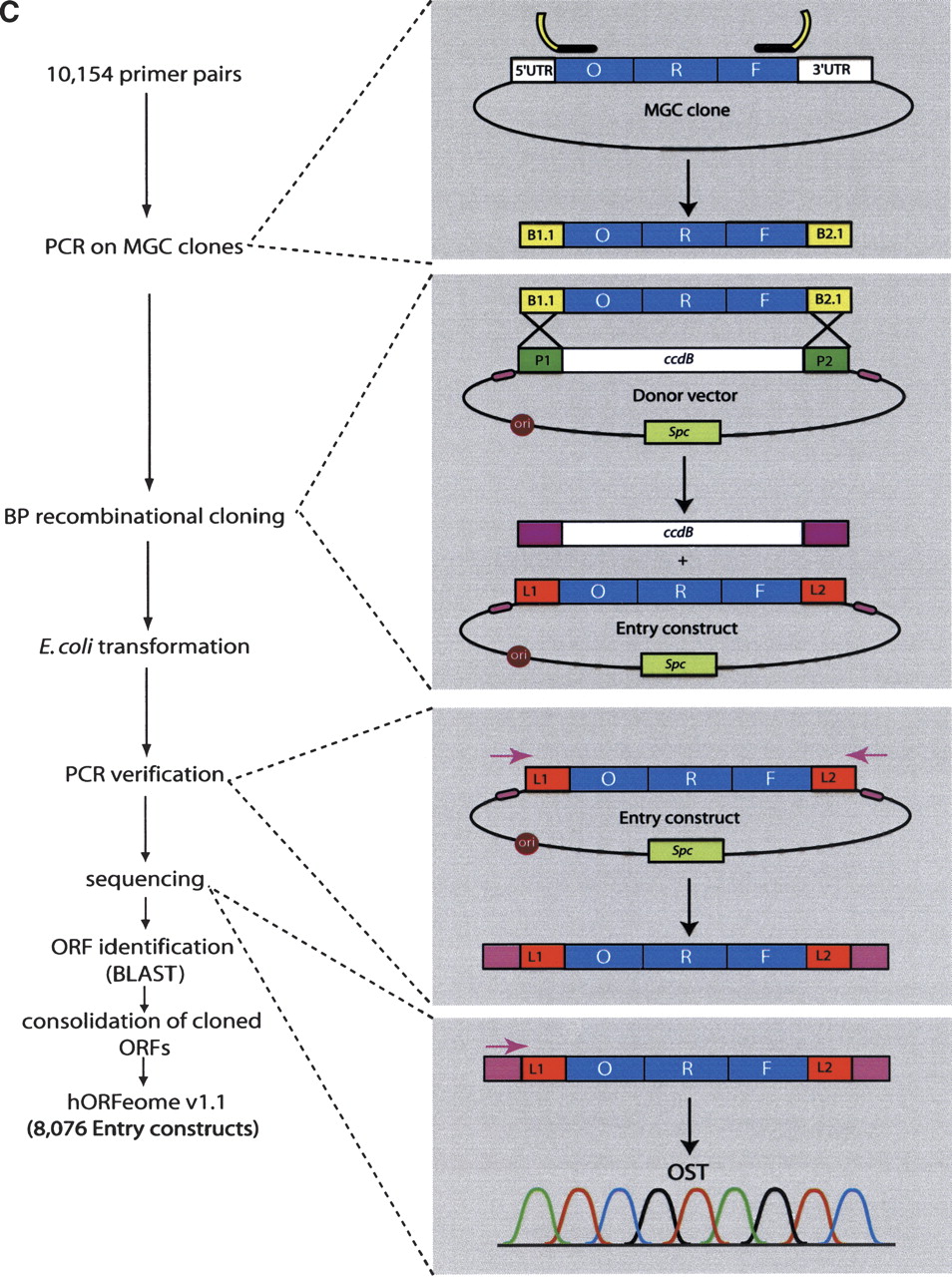
(A) Outline of the Gateway recombination reaction used for generation of hORFeome v1.1. PCR amplification of human ORFs (blue boxes) was performed on isolated MGC cDNA clones. In the depiction of the gene-specific primers, yellow nucleotides represent the altered attB recombination sites (attB1.1 and attB2.1), and blue nucleotides represent the coding sequence in the ORF. PCR-amplified ORFs are cloned by a unidirectional recombinational cloning reaction via their flanking attB1.1 and attB2.1 recombination sites into the pDONR223 Gateway Donor vector. On the Donor vector, the universal Fwd and Rev sequencing primers, the origin of replication (ORI), and the spectinomycin (Spc) selectable marker are indicated. (B) Defining a first version of the human ORFeome starting from the MGC (Mammalian Gene Collection) Resource. The MGC contained 12,710 available full-length human cDNA clones at the time this project was begun. We designed pairs of primers for the PCR amplification of 10,154 distinct full-length ORFs. Asterisks indicate sequence polymorphisms. (C) Scheme for the generation of the hORFeome v1.1 resource. A total of 10,154 pairs of ORF-specific primers were designed to PCR amplify all nonredundant ORFs present in the MGC collection as of March 2004. Amplified ORFs were cloned into the pDONR223 Donor vector by BP recombinational cloning. PCR amplification of cloned inserts for sequence verification was then done using the Fwd and Rev primers that flank the cloning site. Sequencing was performed on the 5′ end with the Fwd primer to generate ORF Sequence Tags (OSTs), and ORFs were then identified by BLAST analysis against the complete MGC set of 10,154 nonredundant clones. Successfully cloned ORFs were consolidated onto new plates, generating the hORFeome v1.1 resource.


