


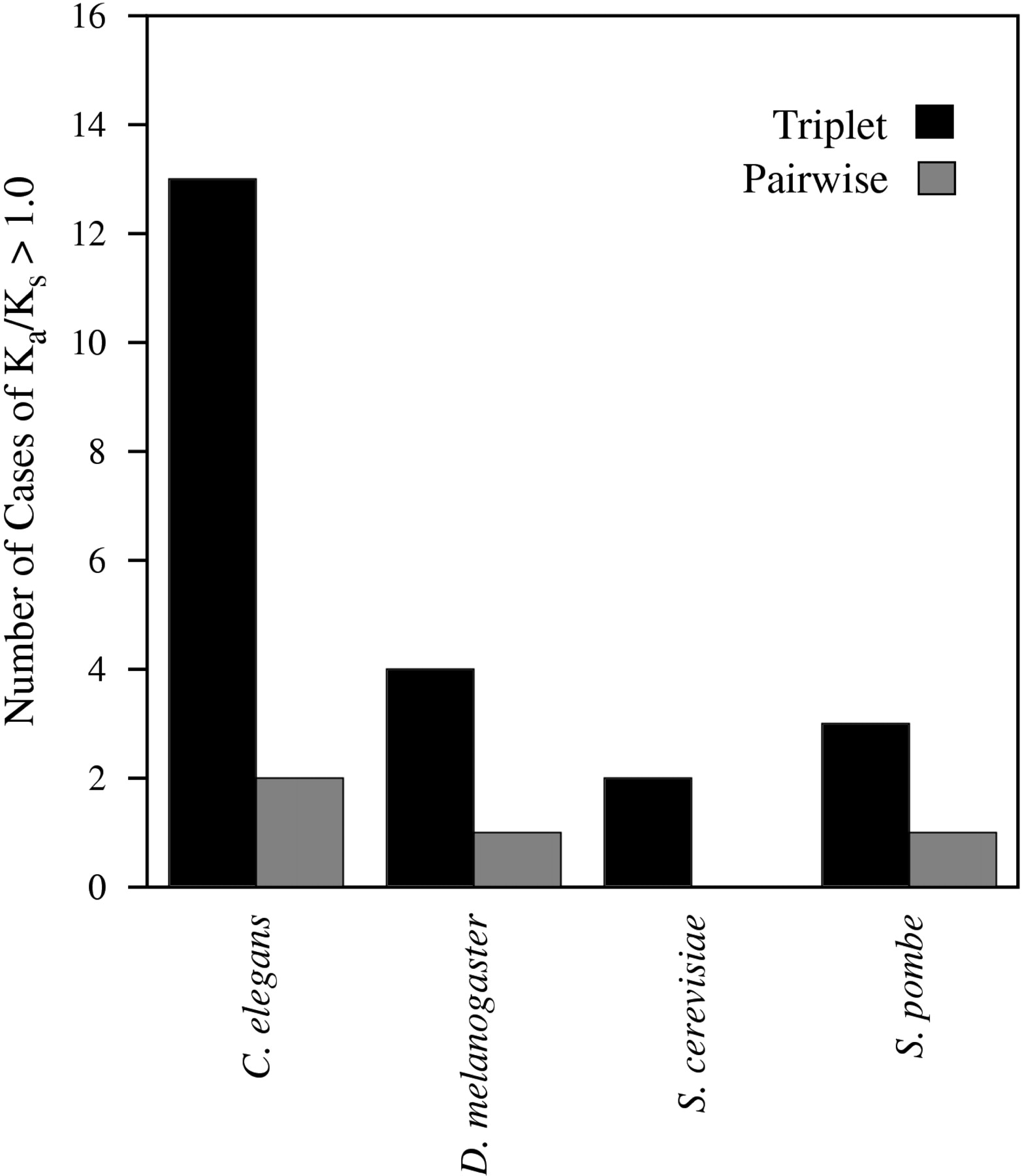
Figure 4
Triplet-based analysis is more sensitive in detecting positive selection. Number of cases where at least one duplicate in a pair has Ka/Ks > 1.0 for the four organisms shown using our triplet method (black) and using the conventional pairwise estimation (grey). The total number of duplicates pairs for which we determined Ka/Ks in this analysis was 22 for S. cerevisiae, 14 for S. pombe, 44 for D. melanogaster, and 164 for C. elegans.



